
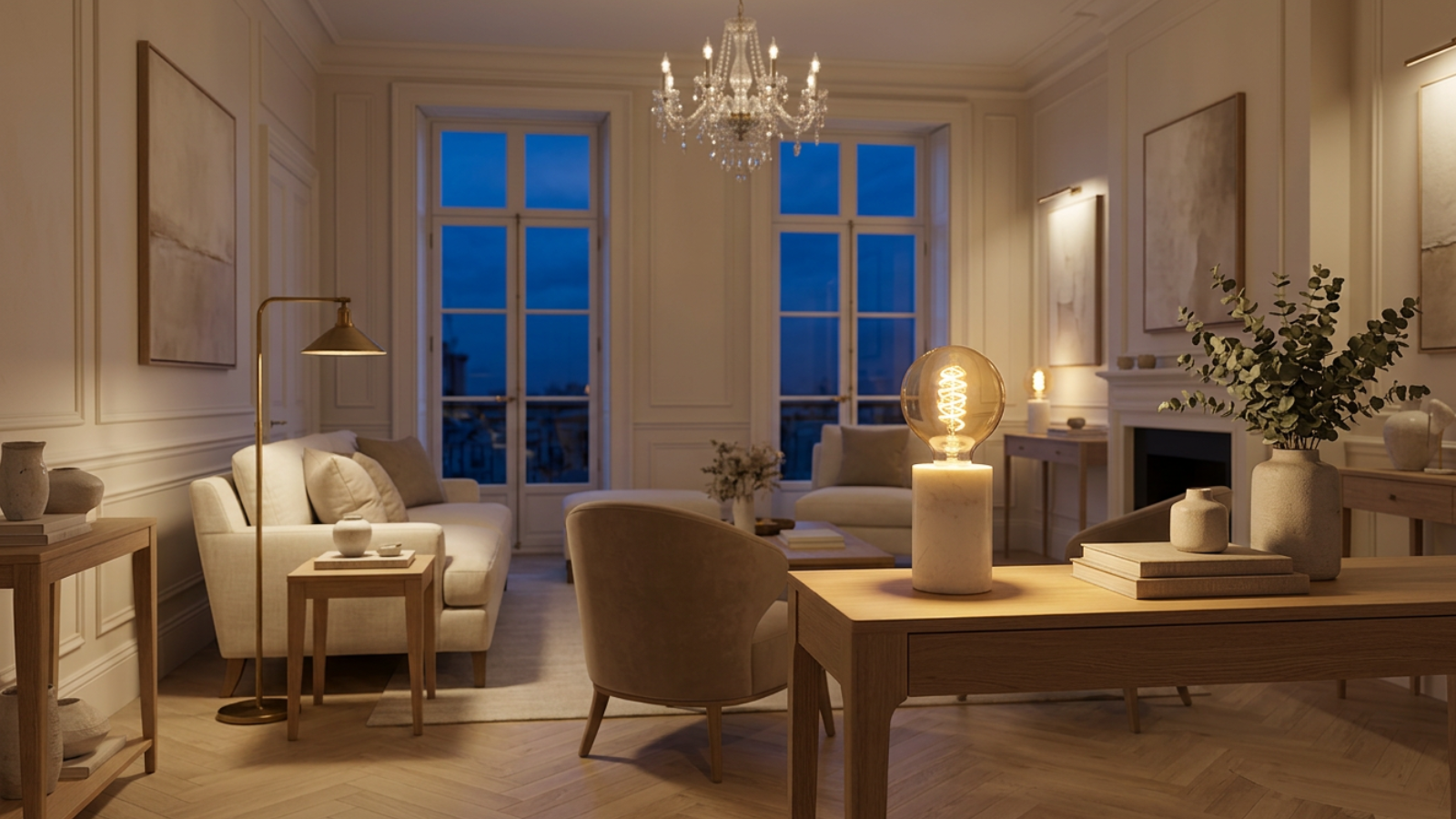
Lighting has an unusual influence over a living room.
The furniture can be beautifully proportioned. The colours can work together. The artwork, textiles and decorative objects can all have been chosen carefully. Yet when a room relies on a single ceiling light, much of that character can disappear as soon as daylight fades.
Well-designed living rooms rarely depend on one source of light.
Instead, they use layers of lighting at different heights and for different purposes, allowing the atmosphere of the room to change throughout the day.
A table lamp might cast a warm pool of light across a console table. A floor lamp beside an armchair can create a comfortable place to read. Wall lights can illuminate architectural details without dominating them. A pendant or chandelier can provide a central decorative feature while softer lamps around the room create the atmosphere in which people actually want to spend time.
This approach is known as layered lighting.
And although it is frequently associated with professionally designed interiors, the principle is surprisingly straightforward to apply at home.
The secret is not simply adding more lamps.
It is understanding what each source of light is supposed to do, where it should sit within the room and how it interacts with every other layer.
To layer living room lighting effectively, combine ambient lighting for general illumination, task lighting for activities such as reading, and accent lighting to highlight furniture, artwork or architectural details. Position light sources at different heights and use warm, dimmable lighting to create depth and atmosphere.
16 min read.
When planning living room lighting, don't begin by asking how many lamps the room needs. Instead, look at the room after daylight has faded and identify which areas disappear. A reading chair, console table, bookcase or architectural feature that becomes lost after dark is often telling you exactly where the next layer of light should be introduced.
What Is Layered Lighting?
Layered lighting is the practice of combining several types and sources of light within the same room rather than expecting one fitting to perform every function.
Most successful lighting schemes contain three principal layers:
Ambient Lighting
Ambient lighting provides the room's general illumination.
This might come from a ceiling pendant, chandelier, recessed lighting, wall lights or another source capable of illuminating a significant part of the space.
Think of ambient lighting as the foundation.
It allows you to move comfortably through the room and establishes its overall level of brightness, but it does not necessarily create atmosphere on its own.
Task Lighting
Task lighting provides more concentrated illumination wherever a particular activity takes place.
In a living room, this could include:
- A floor lamp beside a reading chair.
- A table lamp near a sofa.
- A directional light beside a desk.
- A lamp positioned where somebody regularly reads or works.
Its purpose is practical, but practical lighting does not need to feel utilitarian.
A beautifully proportioned lamp can simultaneously provide useful light and become part of the room's decoration.
Accent Lighting
Accent lighting draws attention towards particular elements of the interior.
It might illuminate artwork, highlight architectural mouldings, emphasise shelving or cast a softer glow across a console table or sideboard.
This layer often contributes disproportionately to the atmosphere of a room because it creates contrast between brighter and darker areas.
Rather than illuminating everything equally, accent lighting allows certain details to emerge while others recede.
The result feels more dimensional.
Why One Ceiling Light Is Rarely Enough
Walk into many living rooms after sunset and the entire space is illuminated from a single point in the ceiling.
Technically, the room is lit.
But illumination and atmosphere are not the same thing.
A single overhead source tends to distribute light from one height and one direction. Depending on the fitting, this can flatten textures, create stronger shadows beneath facial features and leave parts of the room either excessively bright or comparatively dark.
Layered lighting introduces variation.
Instead of light falling exclusively from above, it can appear:
- At ceiling height.
- Around eye level.
- At table height.
- Beside seating.
- Across walls.
- Behind or within furniture.
These different points of illumination create depth.
Wood grain becomes more visible. Upholstery gains texture. Brass and polished metal catch small highlights. Decorative objects create subtle shadows. Architectural mouldings become more pronounced.
This is one reason beautifully designed interiors often appear particularly inviting in the evening.
The room has not simply been made brighter.
Light has been distributed intentionally.
Start With How You Actually Use the Living Room
Before choosing lamps or light fittings, consider what happens in the room.
A living room used primarily for conversation requires a different lighting scheme from one regularly used for reading, television, entertaining or working from home.
Ask yourself:
Where do people naturally sit?
Where do you read?
Which areas become too dark after sunset?
Which furniture or architectural features deserve attention?
Where does natural daylight enter during the day?
Which lights would you want illuminated during a quiet evening rather than when cleaning the room?
These questions reveal where lighting is actually required.
For example, a large sofa might benefit from a table lamp at one end and a floor lamp at the other.
An occasional chair in a corner may need its own light source to prevent that part of the room disappearing after dark.
A console table beneath a mirror can become an atmospheric focal point with a carefully positioned lamp.
A large bookcase might require subtle accent lighting rather than another general lamp.
The objective is to create small interconnected zones of light throughout the room.
When viewed together, those zones form the complete lighting scheme.
Think About Lighting at Different Heights
One of the simplest ways to recognise an underdeveloped lighting scheme is to look at where all the light originates.
If every source is at ceiling height, the room can feel flat.
If every lamp sits at approximately the same height, the effect can feel equally repetitive.
Instead, create variation.
A chandelier or pendant establishes the highest layer.
Wall lights occupy the middle of the composition.
Floor lamps introduce another level beside seating.
Table lamps create smaller pools of light on consoles, side tables and occasional furniture.
Even candlelight can contribute a low, intimate layer when appropriate.
The exact combination will depend on the room, and there is no requirement to include every possible type of lighting.
What matters is that the eye encounters illumination at more than one level.
This gives the room visual rhythm after dark in much the same way that furniture of different heights creates rhythm during daylight.
Use Table Lamps to Create Pools of Light
Table lamps are among the most useful tools for creating atmosphere in a living room.
Unlike overhead lighting, which tends to illuminate a broad area, a table lamp creates a more concentrated pool of light around the furniture on which it sits.
This can make a console table, sideboard or side table feel like a distinct composition within the larger room.
The lamp itself also contributes to the interior when switched off.
Its base introduces material and form. Its shade contributes colour and texture. Its height can balance artwork or a mirror positioned nearby.
A sculptural design such as the Amélie Table Lamp – White Marble Base with Bulb can also introduce material contrast during daylight, allowing the lamp to function as part of the decorative composition even when it isn't illuminated.
For this reason, choose table lamps as you would choose other pieces of decorative furniture.
Consider their relationship with:
- The width and height of the surface beneath them.
- Nearby artwork or mirrors.
- Other decorative objects.
- The height of surrounding furniture.
- The visual weight of the lamp base and shade.
A substantial sideboard may comfortably support a larger lamp.
A narrow console often benefits from something more restrained.
On a side table beside a sofa, the lamp should feel appropriately scaled to both the table and the seating rather than appearing miniature beside a large upholstered piece.
The goal is not simply to find somewhere a lamp will fit.
It is to make the lamp feel architecturally connected to the furniture beneath it.
In bedrooms, the furniture beneath the lamp matters just as much. Our guide to How to Choose the Perfect Bedside Table for Your Bedroom explores how bedside-table height, width and surface space should relate to the bed and lamp.
Use Floor Lamps to Give Seating Areas Their Own Light
Floor lamps are particularly useful because they allow you to introduce light without requiring another piece of furniture to support it.
They can also help establish individual zones within a larger living room.
A floor lamp positioned beside an armchair, for example, does more than provide somewhere to read.
It gives the chair a sense of purpose.
Without the lamp, an occasional chair placed towards the edge of a room can sometimes feel disconnected from the main seating arrangement. Add a floor lamp and perhaps a small side table, and the same corner begins to feel like an intentional reading area.
Floor lamps can work particularly well:
- Beside an armchair.
- At the end of a sofa.
- Within an otherwise dark corner.
- Beside a reading area.
- Between separate seating zones in a larger room.
Scale matters here too.
A very slender floor lamp can disappear beside substantial upholstered furniture, while an oversized design may dominate a smaller chair.
Consider the visual weight of both pieces together.
Think About Where the Light Actually Falls
The position of the bulb and shade is just as important as the appearance of the lamp itself.
For reading, the light needs to reach the page comfortably rather than illuminating only the wall behind the chair.
For atmospheric lighting, the requirement is different.
A softly shaded floor lamp can cast a wider glow around the seating area without needing to function as concentrated task lighting.
This distinction is important because not every lamp needs to perform every role.
One floor lamp might exist primarily for reading.
Another might exist primarily to make a previously dark corner feel connected to the rest of the room.
Both can be valuable within the same lighting scheme.
How to Light a Console Table
Console tables provide one of the best opportunities for introducing a decorative layer of lighting.
Lighting is only one part of creating a balanced console arrangement. Our guide to How to Style a Console Table Like an Interior Designer explores how lamps can be combined with mirrors, decorative objects, books and negative space to create a more considered composition.
A table lamp positioned on a console creates a focal point at approximately eye level while illuminating the objects and wall treatment surrounding it.
A carefully proportioned console table provides an especially useful surface for this lower layer of lighting because it allows the lamp to become part of a wider decorative arrangement.
This is particularly effective when the console sits:
- In an alcove.
- Behind a sofa.
- Against a long living-room wall.
- Beneath artwork.
- Beneath a wall mirror.
- Between architectural features.
The lamp should feel like part of the console arrangement rather than an appliance placed there purely because a socket is nearby.
Consider its relationship with the other objects on the surface.
A lamp at one end might be balanced by a vase, sculpture or arrangement of branches towards the other.
Alternatively, two lamps can create a more formal symmetrical composition where the furniture and architecture suit it.
Neither approach is inherently better.
The important thing is that the lighting and styling appear intentional together.
Leave Some of the Surface Unoccupied
It can be tempting to fill the remaining console surface once a lamp has been added.
Resist that instinct.
Lighting becomes more effective when there is enough negative space around it for the eye to recognise the individual composition.
A lamp, two or three carefully selected decorative objects and an expanse of visible furniture surface will often feel more considered than a large collection of small accessories.
The pool of light itself becomes part of the styling.
✦ Maison Jahvauns Editor's Note
Switch a console lamp on before finishing the styling around it. Objects that appear perfectly balanced in daylight can create very different shadows after dark. Evening light may reveal that one fewer object—or simply a little more space between them—creates the stronger composition.
How to Light a Sideboard
A sideboard offers similar possibilities to a console table but usually on a larger scale.
Because sideboards tend to be wider and visually heavier, they can often support more substantial lamps.
One large lamp positioned towards one end can establish asymmetry and leave room for artwork, books, ceramics or flowers elsewhere.
Alternatively, matching lamps positioned at either side can create a more formal arrangement.
This works particularly well when the sideboard is centred beneath:
- A large mirror.
- A substantial piece of artwork.
- A symmetrical architectural feature.
The choice between one lamp and two should therefore respond to the wider composition rather than to a rule.
Avoid Treating the Sideboard as a Lighting Station
A sideboard may provide enough surface area for several lamps, candles and decorative lights.
That doesn't mean they should all be used.
Remember that the purpose of layering is not to illuminate every surface independently.
It is to distribute light across the room.
If a floor lamp already illuminates the nearby seating area and wall lights provide another layer, one well-positioned table lamp on the sideboard may be entirely sufficient.
Use Mirrors to Multiply the Effect of Lighting
Mirrors and lighting have a particularly useful relationship.
A carefully positioned wall mirror near a lamp can reflect both the light itself and the illuminated interior around it, creating greater visual depth after dark.
The size, shape and position of the mirror will influence that effect considerably. Our guide to How to Choose the Perfect Wall Mirror for Every Room explores mirror scale, placement and reflection in greater detail.
This is especially effective with:
- Console tables.
- Sideboards.
- Fireplace arrangements.
- Hallways opening into the living room.
- Larger decorative wall mirrors.
The effect should still feel controlled.
A lamp positioned directly in front of a mirror may produce an unnecessarily bright reflected bulb depending on the shade and viewing angle.
Moving the lamp slightly to one side can often create a softer reflection.
Think About the Reflection After Dark
As we discussed when choosing wall mirrors, what appears within the reflection matters.
During daylight, a mirror may beautifully capture a window.
After sunset, that same mirror might instead reflect a table lamp, chandelier or illuminated architectural feature.
This gives the mirror two different roles throughout the day.
Before finalising the arrangement, view it with the evening lighting switched on.
The most successful position is often one that works in both conditions.
Use Lighting to Bring Bookcases and Shelving to Life
Large bookcases can become visually heavy after dark.
Lighting works most effectively when the objects within the shelving have already been given sufficient space and hierarchy. Our guide to Styling a Large Bookcase Without Creating Clutter explores how books, ceramics, artwork and negative space can be arranged before lighting is introduced.
During the day, natural light reveals books, ceramics, artwork and the depth of the shelving.
At night, those details can disappear into shadow.
Accent lighting can prevent this.
Depending on the furniture and room, this might come from:
- A nearby table lamp.
- A floor lamp positioned beside the bookcase.
- Discreet integrated shelf lighting.
- Wall-mounted picture lights.
- Directional architectural lighting.
The objective isn't necessarily to illuminate every shelf equally.
In fact, perfectly uniform illumination can remove some of the depth that makes a large bookcase visually interesting.
Allowing certain areas to remain slightly darker can create contrast and help individual objects stand out.
Light What Matters
If a bookcase contains a favourite sculpture, collection of ceramics or piece of artwork, consider allowing the lighting to emphasise that particular area.
This creates hierarchy.
The eye understands where to look first rather than processing every shelf with equal importance.
The same principle applies to the wider living room.
Good lighting doesn't demand that everything receives equal attention.
It helps decide what deserves attention.
Use Accent Lighting to Highlight Art and Architecture
Some of the most effective lighting in a living room is not directed towards people or furniture at all.
It is directed towards the architecture.
Wall mouldings, fireplaces, alcoves, artwork and textured surfaces can become dramatically more noticeable when light falls across them rather than directly towards the centre of the room.
This is where accent lighting becomes particularly valuable.
A picture light can give artwork greater presence after dark.
Wall lights can emphasise the rhythm of architectural panelling.
A directional light can reveal the texture of stone, timber or plaster.
A lamp positioned near a decorative wall can create shadows that make mouldings more pronounced.
The effect doesn't need to be dramatic.
Subtle differences in brightness are often enough to give a room significantly greater depth.
Should Living Room Lighting Be Symmetrical?
Symmetry can create a sense of formality and order.
Two matching lamps positioned at either end of a sideboard can feel calm and architectural.
Matching table lamps on either side of a sofa can create a similarly balanced arrangement.
But a beautifully layered room does not require every light source to have a partner.
Asymmetrical lighting often feels more natural because it responds to how different areas of the room are actually used.
You might have:
- A floor lamp beside one armchair.
- A table lamp at one end of the sofa.
- Another lamp on a console across the room.
- A picture light illuminating artwork elsewhere.
None of these needs to match.
They simply need to feel related.
Aim for Visual Balance Rather Than Duplication
Instead of asking whether both sides of the room contain identical lamps, consider whether they contain comparable visual weight.
A tall floor lamp on one side might be balanced by a substantial table lamp and artwork on the other.
A pair of small wall lights might balance a larger lamp elsewhere.
This approach creates a room that feels composed without becoming overly formal.
It also contributes to the collected-over-time quality that often makes an interior feel more personal.
What Colour Temperature Is Best for a Living Room?
Colour temperature describes whether white light appears warmer or cooler and is measured in Kelvin (K).
Lower Kelvin values generally produce warmer, more golden light.
Higher values appear progressively cooler and closer to crisp white or daylight.
For living rooms, warm white light around 2700K is often an excellent starting point because it creates a comfortable atmosphere while complementing many residential materials and finishes.
Warm light tends to work particularly beautifully with:
- Natural timber.
- Cream and beige upholstery.
- Brass and gold finishes.
- Warm stone.
- Off-white walls.
- Traditional furniture.
- Candlelight.
Some interiors may suit slightly different temperatures, but consistency matters.
Avoid Mixing Obviously Different Whites Without a Reason
One lamp glowing warmly while another produces noticeably cool white light can make the room feel visually disconnected.
Where several lamps contribute to the same evening atmosphere, using bulbs with similar colour temperatures generally creates a more coherent result.
This does not mean every light needs identical brightness.
Brightness can vary considerably.
The character of the light, however, should usually feel related.
Pay Attention to Brightness, Not Just Bulb Wattage
Traditional incandescent bulbs encouraged people to think about brightness in watts.
With modern LED lighting, lumen's provide the more useful indication of how much visible light a bulb produces.
This matters because two LED bulbs with similar wattage's can produce different amounts of light.
But when layering a living room, the objective isn't to maximise the lumen output of every lamp.
Different lights can have different roles.
A reading lamp may need stronger illumination.
A decorative console lamp may need considerably less.
Accent lighting might be deliberately subtle.
Think about the brightness of the complete room, not each fitting in isolation.
Several lower-intensity sources distributed around the room can create a much more comfortable environment than one extremely bright central source.
Why Dimmers Make Such a Difference
If there is one practical feature capable of making a layered lighting scheme significantly more flexible, it is dimming.
The amount of light required at 4pm on a winter afternoon may be very different from what feels comfortable at 10pm while watching television or talking with friends.
Dimmers allow the same fittings to respond to those changing requirements.
They are particularly useful for:
- Chandeliers.
- Ceiling pendants.
- Wall lights.
- Architectural lighting.
- Compatible table and floor lamps.
Rather than thinking of each light as simply on or off, dimming allows you to determine how strongly each layer participates in the room.
A chandelier might provide substantial illumination when entertaining, then be reduced to a gentle glow later in the evening.
Wall lights can provide background illumination while table lamps become the dominant sources closer to seating.
The room changes without any furniture moving at all.
Always ensure that the bulb, fitting and dimmer are designed to work together.
Create an Evening Lighting Scene
One of the most useful ways to think about living-room lighting is to stop considering individual lamps and instead imagine scenes.
For example:
Everyday Evening
A table lamp beside the sofa.
A floor lamp near an armchair.
A console lamp across the room.
Overhead lighting either dimmed considerably or switched off.
Reading
The general evening lighting remains soft while a dedicated floor or table lamp provides stronger task lighting beside the reader.
Entertaining
More of the room may be illuminated.
A chandelier or pendant can contribute alongside wall lights and lamps, allowing guests to move comfortably through the space while retaining atmosphere.
This combination of lower-level lamps, architectural lighting and restrained overhead illumination is particularly effective in layered European-inspired interiors. For the wider furniture and styling principles behind the look, explore How to Curate a Parisian Salon in Your Home.
Watching Television
Background lamps can remain illuminated to prevent the television becoming the only bright object in an otherwise dark room.
Keep the lighting soft and positioned so that it does not create distracting reflections on the screen.
If the television itself is also disrupting the visual balance of the room, our guide to Hidden TV Cabinets: The Luxury Living Room Explained explores ways of integrating technology more discreetly into a considered interior.
The ability to create these different moods is one of the greatest advantages of layered lighting.
You are no longer asking:
“Is the living room light on?”
You are deciding:
“How should the living room feel right now?”
How Many Lamps Does a Living Room Need?
There is no ideal number.
A compact living room might achieve an effective layered scheme with a ceiling fitting, one table lamp and one floor lamp.
A larger room containing several seating areas may require considerably more.
Room size alone doesn't determine the answer either.
Furniture layout, natural light, wall colour, ceiling height and how the space is used all influence the number of sources required.
Instead of counting lamps, look for dark zones and missing layers.
If one side of the room disappears after sunset, another source may be useful.
If every corner is already evenly illuminated, adding another lamp simply to reach a predetermined number is unlikely to improve the room.
This is why layered lighting is best approached visually rather than mathematically.
Layer Lighting Around the Furniture, Not the Other Way Around
Lighting works most naturally when it responds to the furniture arrangement.
A floor lamp belongs beside the chair where somebody reads.
A table lamp belongs on the console that needs evening presence.
A side-table lamp belongs beside the sofa where softer light is useful.
Accent lighting belongs near the object or architectural feature you want to emphasise.
This sounds simple, but it prevents a common problem: designing a perfectly symmetrical lighting plan before considering how the room will actually be furnished.
The furniture establishes how people use the space.
That relationship begins with a well-planned furniture arrangement. If you're refining the centre of your seating area, our guide to How to Choose the Perfect Coffee Table for Your Living Room explores scale, circulation and proportion in greater detail.
The lighting should support that behaviour.
When both are planned together, the room becomes more intuitive as well as more beautiful.
The Maison Jahvauns Principle
A beautifully lit living room should never feel as though every light has been switched on simply to make the space brighter.
The aim is contrast, depth and atmosphere.
Some areas can be brighter.
Some can remain quieter.
A reading chair can have its own concentrated pool of light while a console lamp creates a softer glow across the room.
Artwork can be gently emphasised while the corners around it remain subdued.
A chandelier can provide architectural presence without needing to dominate every evening.
Think of lighting in the same way you might think about furnishing a room.
Not every piece needs to be the focal point.
Not every surface needs decoration.
And not every part of the room needs equal illumination.
The most convincing lighting schemes create a hierarchy.
They guide the eye through the interior, reveal materials and textures, support the way the room is used and allow the atmosphere to change naturally between day and night.
The goal is not to light everything.
It is to light the right things, in the right places, at the right time.
Common Living Room Lighting Mistakes
Even a beautifully furnished living room can feel uncomfortable after dark when its lighting hasn't been considered as carefully as its furniture.
Avoiding a few common mistakes can make the difference between a room that is simply bright and one that feels genuinely inviting.
Relying on One Ceiling Light
Perhaps the most common mistake is expecting a single overhead fitting to illuminate the entire living room.
A ceiling light can provide useful general illumination, but relying on it alone usually means that all the light enters the room from one height and direction.
Introduce table lamps, floor lamps or wall lighting to create smaller pools of light throughout the space.
Making Every Part of the Room Equally Bright
Good lighting does not require uniform brightness.
When every wall, corner and piece of furniture receives approximately the same amount of light, the room can lose depth.
Allow some areas to remain quieter while intentionally illuminating seating, artwork, furniture and architectural features.
Contrast creates atmosphere.
Choosing Lamps That Are Too Small
A lamp should relate comfortably to the furniture around it.
A very small table lamp can look insignificant on a substantial sideboard, while a delicate floor lamp may appear lost beside a generously proportioned sofa or armchair.
Consider the lamp as part of the furniture composition rather than as a separate accessory.
Using Only One Height of Lighting
Several table lamps can improve a room, but if every source sits at approximately the same height, the scheme may still feel relatively flat.
Where appropriate, combine ceiling lighting, wall lighting, floor lamps and table lamps to introduce illumination at different levels.
Mixing Very Different Colour Temperatures
A warm table lamp beside a noticeably cool-white floor lamp can make the room feel visually disconnected.
Where several light sources contribute to the same evening atmosphere, keeping their colour temperatures broadly consistent generally creates a more harmonious result.
For many living rooms, warm white light around 2700K provides an effective starting point.
Choosing Brightness Without Considering Purpose
The brightest bulb isn't automatically the best bulb.
A reading lamp may require concentrated illumination, while a lamp positioned on a console may exist primarily to create atmosphere.
Think about what each light is intended to accomplish before deciding how bright it needs to be.
Forgetting About Glare and Reflections
Lighting should remain comfortable from the positions where people actually sit.
A visible bulb, strong reflection in a mirror or lamp reflected across a television screen can become distracting.
After arranging the lighting, sit in each of the main seating positions and look around the room.
Small changes in lamp position can often eliminate glare without changing the overall scheme.
Placing Lamps Wherever There Is a Socket
Electrical sockets naturally influence lamp placement, but they shouldn't determine the entire lighting arrangement.
A lamp should ideally support the furniture, activity or feature beside it.
Plan lighting according to how the room is used first, then consider the most practical way to provide power safely.
Forgetting How the Room Looks With the Lights Switched Off
Lamps are part of the interior during daylight too.
Their proportions, materials, shades and silhouettes should complement the furniture even when they aren't illuminated.
A beautiful lighting scheme therefore considers both the quality of the light and the design of the objects producing it.
✦ Maison Jahvauns Editor's Note
One of the easiest ways to assess your living-room lighting is to switch off the main ceiling light after sunset and look around the room. The areas that disappear completely often reveal where another layer of light could be useful. You may discover that repositioning an existing lamp is enough.
Frequently Asked Questions
What are the three layers of lighting in a living room?
The three principal layers are ambient, task and accent lighting.
Ambient lighting provides general illumination throughout the room. Task lighting provides more concentrated light for activities such as reading, while accent lighting highlights artwork, furniture, architectural features or decorative objects.
Combining these layers creates greater depth and flexibility than relying on one source alone.
What colour temperature is best for living-room lighting?
Warm white light around 2700K is often an excellent starting point for living rooms because it creates a comfortable atmosphere and works particularly well with natural timber, cream upholstery, warm metals and traditional interiors.
The most appropriate temperature ultimately depends on the room, but keeping related evening light sources reasonably consistent generally creates a more cohesive effect.
How many lamps should you have in a living room?
There is no ideal number of lamps.
A smaller living room might require only a table lamp and floor lamp alongside its general lighting, while a larger room containing several seating areas may need more.
Rather than counting lamps, identify where light is required for particular activities and which areas become excessively dark after sunset.
Should you use table lamps and floor lamps together?
Yes.
Combining table and floor lamps is an effective way to introduce light at different heights.
A table lamp can create a pool of light around a console, sideboard or side table, while a floor lamp can illuminate a reading chair or darker corner without requiring another piece of furniture beneath it.
Should all living-room lamps match?
No.
Living-room lamps don't need to come from the same collection or have identical bases and shades.
They should instead feel visually related through elements such as material, scale, colour, shape or overall character.
A mixture of complementary lamps often creates a more layered, collected appearance than an identical matching set.
Where should a floor lamp be placed in a living room?
Floor lamps work particularly well beside sofas, armchairs, reading areas and darker corners.
The ideal position depends on what the lamp is intended to do.
For reading, ensure the light falls comfortably onto the reading area. For atmospheric lighting, position the lamp where its glow helps connect a darker part of the room with the wider lighting scheme.
Where should table lamps be placed in a living room?
Table lamps can work on side tables, console tables, sideboards and other occasional furniture.
Choose positions where the lamp contributes either useful illumination or atmosphere and ensure its scale feels appropriate to the furniture beneath it.
Should living-room lighting be symmetrical?
Not necessarily.
Matching lamps can create an elegant, formal arrangement, particularly on either side of a sofa or sideboard.
Asymmetrical lighting can feel equally balanced when different light sources have comparable visual weight and respond naturally to how different areas of the room are used.
Should you use the ceiling light in a living room?
Yes, when it serves a purpose.
A ceiling light can provide valuable general illumination when entertaining, cleaning or moving around the room.
For quieter evenings, however, you may prefer to dim it considerably or switch it off and rely more heavily on table lamps, floor lamps and other lower-level lighting.
Are dimmable lights worth having in a living room?
Dimming can make a living-room lighting scheme considerably more flexible.
It allows the same fitting to provide stronger illumination when required and a softer atmosphere later in the evening.
Always ensure the fitting, bulb and dimmer are compatible with one another.
How can I make my living room feel cosier with lighting?
Rather than simply increasing brightness, introduce several warm light sources around the room at different heights.
Table lamps, floor lamps and dimmed architectural lighting can create smaller pools of illumination while allowing some areas to remain more subdued.
Warm colour temperatures, appropriate lamp shades and avoiding excessive overhead brightness can all contribute to a more intimate atmosphere.
What is the best lighting for watching television?
Keep some soft background lighting illuminated rather than watching a bright television in an otherwise completely dark room.
Table or floor lamps positioned away from the screen can provide gentle ambient illumination, but check that they don't create distracting reflections across the television.
Conclusion
A beautifully lit living room isn't necessarily one containing the greatest number of lamps.
It is one where every source of light has a reason to be there.
Ambient lighting establishes the foundation.
Task lighting supports the activities that take place within the room.
Accent lighting introduces depth and allows furniture, artwork and architecture to emerge after daylight fades.
Together, these layers transform lighting from something purely functional into part of the interior itself.
Begin with how you use the room.
Identify where people sit, read, talk and relax. Notice which areas become dark after sunset and which furniture or architectural details deserve greater emphasis.
Then introduce light at different heights.
A floor lamp beside an armchair can establish an intimate reading area.
A table lamp can give a console or sideboard evening presence.
A mirror can reflect a carefully positioned lamp and extend its visual effect.
Accent lighting can reveal artwork, bookcases and architectural detailing that might otherwise disappear after dark.
And a dimmed chandelier or ceiling pendant can provide an elegant upper layer without needing to dominate the entire scheme.
There is no universal formula for how many lamps a living room requires.
Nor should every source match perfectly or illuminate the room with identical brightness.
The most successful schemes respond to the individual room.
They combine practicality with atmosphere, creating enough light where it is needed while preserving quieter areas that give the interior depth.
Ultimately, layered lighting is about having greater control over how your home feels.
Because the living room you need on a winter afternoon may not be the living room you want later that evening.
Thoughtful lighting allows the same furniture, architecture and decorative objects to take on a different character as the day changes.
And when every layer works together, the room doesn't simply become brighter after dark.
It comes to life.
Editorial Standards
Written by Shackeem — Founder & Furniture Curator, Maison Jahvauns
Maison Jahvauns was founded with a simple belief: exceptional furniture should be timeless, thoughtfully curated and designed to elevate the way we live. Every collection is personally selected by Shackeem, with a focus on refined craftsmanship, elegant proportions and enduring design inspired by Parisian interiors.
The Jahvauns Journal reflects the same philosophy. Every guide is written to help homeowners make informed furniture and interior design decisions through practical advice, timeless styling principles and carefully researched buying guidance. Rather than following short-lived trends, our articles are created to inspire elegant homes that remain beautiful for years to come.
Our Editorial Promise
Every article published in the Jahvauns Journal is independently written by Maison Jahvauns and reviewed for accuracy before publication. Our recommendations are based on timeless design principles, thoughtful furniture curation and a commitment to helping readers create refined interiors with confidence.
We regularly review and update our editorial content to ensure it remains relevant, accurate and valuable for our readers.
Last updated: 17 August 2026
Part of the Maison Jahvauns Journal — Curated guides for timeless interiors.
Continue Exploring Maison Jahvauns
Explore Our Table Lamps
Discover carefully curated table lamps designed to introduce warm illumination, sculptural form and decorative character to console tables, sideboards, bedside tables and living-room furniture.
Browse Table Lamps
How to Style a Console Table Like an Interior Designer
Discover how lighting, mirrors, decorative objects and negative space can work together to transform a console table into an elegant focal point.
Read the Console Table Styling Guide
How to Choose the Perfect Wall Mirror for Every Room
Learn how mirror size, shape, placement and reflection can influence light, proportion and atmosphere throughout the home.
Read the Wall Mirror Guide
Styling a Large Bookcase Without Creating Clutter
Discover how lighting, negative space, books and carefully selected decorative objects can help a large bookcase feel layered rather than overcrowded.
Read the Bookcase Styling Guide
How to Choose the Perfect Coffee Table for Your Living Room
Continue refining your living room with our guide to choosing the right coffee table shape, scale, material and proportions for your seating arrangement.
Read the Coffee Table Guide
How to Curate a Parisian Salon in Your Home
Explore how layered lighting, timeless furniture, artwork and decorative objects combine to create the relaxed elegance associated with Parisian-inspired interiors.
Read the Parisian Salon Guide
Explore the Maison Jahvauns Lookbook
Discover curated interiors, timeless furniture and considered styling inspiration throughout the Maison Jahvauns Lookbook.
Explore the Lookbook
Trade & Commercial Projects
Maison Jahvauns supports interior designers, property developers, home staging companies and hospitality businesses with tailored quotations, curated furniture recommendations and personalised project support.
Explore Trade & Commercial