
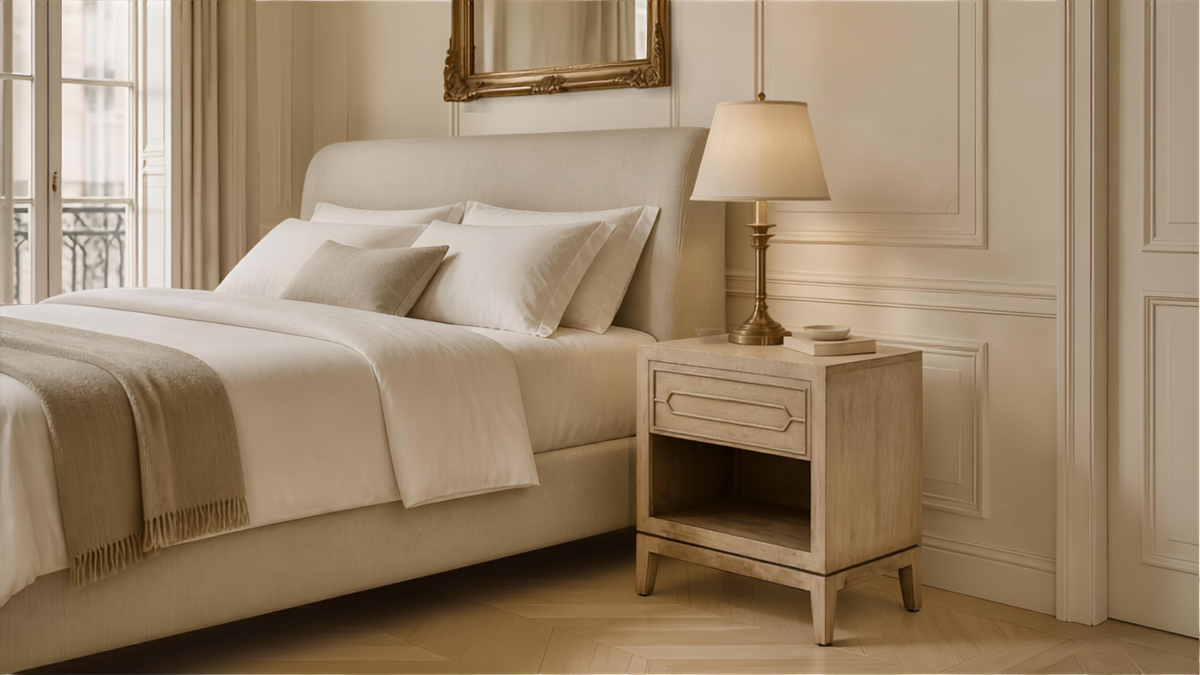
A bedside table is one of the smallest pieces of furniture in a bedroom, yet choosing the wrong one can affect the room far more than its size might suggest.
Too low, and reaching for a glass of water or switching off a lamp becomes awkward.
Too high, and the table can visually overpower the bed.
Too small, and everyday essentials quickly overwhelm the surface.
Too large, and valuable space around the bed disappears.
The right bedside table has to accomplish several things at once.
It should provide practical storage or surface space, sit comfortably beside the mattress, accommodate lighting and everyday objects, and contribute to the proportions of the wider bedroom.
But it doesn't necessarily need to match the bed.
Nor do both sides of the bed always require identical tables.
Some bedrooms benefit from the symmetry of a matching pair. Others feel more interesting when complementary pieces are allowed to differ slightly in shape, material or function.
The key is understanding scale, height, storage and visual balance before choosing according to appearance alone.
In this guide, we'll explore how to choose the right bedside table for your bedroom, including the ideal height beside a bed, how much surface space you really need, drawers versus open storage, bedside tables for smaller bedrooms and whether matching pairs are always the best choice.
Choose a bedside table that sits approximately level with the top of your mattress and provides enough surface space for essentials such as a lamp, phone and glass of water. Consider the available floor space, storage requirements and proportions of the bed before deciding on its width, depth and design.
15 min read
✦ Maison Jahvauns Editor's Note
Measure your bed after the mattress is in place, not just the height of the bed frame. Mattress thickness can substantially change the finished sleeping height and therefore the bedside table height that feels most comfortable.
Why Bedside Table Height Matters
Height is one of the first measurements to consider because it affects both comfort and proportion.
Bedside furniture is only one part of creating a well-proportioned sleeping space. Explore our Bedroom Retreats collection for beds, bedside tables, wardrobes and complementary furniture curated to create a calm and considered bedroom.
When lying in bed, you should be able to reach the bedside surface naturally without having to stretch significantly upwards or downwards.
For this reason, a bedside table that sits approximately level with the top of the mattress is often a useful starting point.
It doesn't have to align perfectly.
A table slightly above or below mattress height can still work comfortably, particularly when the design of the furniture or height of the bed makes exact alignment impractical.
What should be avoided is a significant difference that makes the table uncomfortable to use or visually disconnected from the bed.
Measure the Complete Bed
Don't rely solely on the manufacturer's dimensions for the bed frame.
Measure from the finished floor to the top of the mattress once the mattress is installed.
If you're choosing the bed itself at the same time, our complete guide to How to Choose the Perfect Bed for Your Bedroom explains how bed size, frame dimensions, headboard proportions and circulation should be assessed before ordering.
This is particularly important with:
- Deep mattresses.
- Mattress toppers.
- Divan bases.
- Tall upholstered beds.
- Low platform beds.
- Traditional bed frames with substantial bases.
Two beds with similarly sized frames can have very different finished mattress heights.
The furniture beside them should respond to that finished measurement.
Once the bed itself has been chosen, its position becomes the foundation of the wider bedroom layout. How to Arrange Bedroom Furniture for a Balanced, Elegant Room explains how to place the bed alongside bedside tables, wardrobes, dressing furniture and clear circulation routes
How Wide Should a Bedside Table Be?
There is no single ideal width.
The right bedside table proportion depends on the size of the bed, the available wall space and what you expect the table to hold.
A very narrow bedside table beside a substantial king-size bed may look visually insignificant.
Equally, an oversized chest beside a smaller bed can make the sleeping area feel cramped.
Start by measuring the space between the side of the bed and the nearest wall, wardrobe, radiator or other obstruction.
Then think about what needs to fit on the surface.
For many people, that might include:
- A bedside lamp.
- A glass or bottle of water.
- A phone.
- A book.
- Glasses.
- A small decorative object.
You don't need enough surface area to display everything you own.
You need enough to accommodate the objects you actually use while leaving some visible space around them.
That negative space matters.
A bedside table permanently covered from edge to edge will rarely contribute to the calm atmosphere most people want from a bedroom.
Bedside furniture should also be planned alongside the bedroom's larger storage pieces. Our guide to How to Choose the Perfect Wardrobe for Your Bedroom explains how wardrobe depth, width and door clearance can influence the space available around the bed.
Don't Forget Bedside Table Depth
Width receives most of the attention, but depth can be equally important.
A bedside table that projects significantly further into the room than the bed can interrupt circulation and appear unnecessarily bulky.
This becomes particularly noticeable in compact bedrooms where the route around the bed is already restricted.
At the same time, an extremely shallow table may not provide enough room for a practical lamp or everyday objects.
Consider the bedside table in plan view.
How far does it project from the wall?
How does that compare with the bed?
Is there enough space to walk comfortably around it?
Can drawers or cupboard doors open without hitting another piece of furniture?
Measurements that appear perfectly reasonable on a product page can feel very different once furniture is placed within a real room.
How Much Space Should You Leave Around a Bedside Table?
A bedside table should not make getting into or moving around the bed unnecessarily difficult.
In larger bedrooms, this is relatively straightforward.
In smaller rooms, every centimetre becomes more important.
Check the available space between:
Bed → bedside table → wall or neighbouring furniture.
Also consider whether there are:
- Wardrobe doors nearby.
- Bedroom doors opening into the area.
- Curtains extending behind the table.
- Radiators.
- Electrical sockets.
- Skirting boards.
- Floor vents.
- Architectural projections.
The objective isn't simply to make the bedside table physically fit.
It should fit while allowing the bedroom to remain comfortable to use.
This is particularly important when buying a pair. A measurement that works perfectly on one side of the bed may not work on the other.
Measure both.
Should a Bedside Table Have Drawers?
Drawers are valuable when the bedroom requires concealed storage.
They allow smaller everyday objects to remain nearby without leaving them permanently visible on the surface.
A bedside drawer might hold:
- Charging cables.
- Medication.
- Reading glasses.
- Hand cream.
- Earphones.
- Notebooks.
- Personal items.
This can help the bedroom maintain a quieter appearance.
But more storage is not automatically better.
A bedside cabinet containing several large drawers can become visually heavy, particularly beside a lighter bed frame or within a compact room.
Consider what you genuinely need to store at the bedside before choosing the largest configuration available.
For many bedrooms, one useful drawer combined with an open or uncluttered lower section provides a good balance between practical storage and visual lightness.
The Soline Bedside Table – Single Drawer Wooden Design follows this restrained approach, providing accessible bedside storage without requiring the visual weight of a larger multi-drawer cabinet.
Open Bedside Tables vs Closed Storage
Open bedside tables can make a room feel lighter because more of the wall and floor remain visually accessible.
They also create opportunities for styling.
A lower shelf might hold:
- Two or three books.
- A small basket.
- A decorative box.
- A carefully selected object.
However, open storage requires more discipline.
Everything remains visible.
If the bedside area naturally accumulates cables, chargers, tissues and other everyday objects, concealed storage may create a calmer result.
Closed cabinets offer the opposite trade-off.
They hide more, but their solid fronts can make the furniture appear heavier.
Neither approach is inherently better.
Choose according to how you actually use the bedside, not simply how the table appears in a styled photograph.
Should Bedside Tables Match the Bed?
No.
A bedside table doesn't need to be manufactured from the same material or belong to the same furniture collection as the bed.
In fact, avoiding an exact furniture suite can often make the bedroom feel more collected and individual.
The same principle applies to other secondary furniture in the room: pieces can feel connected without being identical. If you're adding a separate dressing area, How to Choose the Perfect Dressing Table for Your Bedroom explains how to balance its proportions, materials and storage with the wider bedroom.
Instead of matching everything, look for relationships.
A timber bedside table might relate to:
- The tone of a wardrobe.
- A wooden picture frame.
- Flooring.
- An occasional chair.
- Decorative objects elsewhere in the room.
A painted bedside table might connect with wall panelling or another painted piece of furniture.
Metal handles could quietly repeat the finish of lighting or mirrors.
The relationship can be subtle.
The goal is cohesion, not duplication.
A room often becomes more interesting when pieces appear to have been chosen for one another rather than purchased together automatically.
This collected rather than completely coordinated approach is also central to many Parisian-inspired interiors. Explore How to Curate a Parisian Salon in Your Home for a wider look at combining furniture, materials and decorative objects without relying on matching sets.
Should Both Bedside Tables Match?
Matching bedside tables create immediate symmetry.
This can work beautifully when the bed is centred on a wall and the bedroom has a formal, balanced arrangement.
A matching pair can reinforce the bed as the principal focal point, particularly when combined with:
- Matching lamps.
- Symmetrical artwork.
- Wall lights.
- Balanced architectural features.
But matching tables are not compulsory.
Different bedside tables can work when their proportions and visual weight feel related.
For example, one side might use a small chest with drawers while the other uses a simpler table.
The pieces don't need identical dimensions, but there should be enough connection that one side of the bed doesn't feel substantially heavier than the other.
This is particularly useful when two people have different storage requirements.
Symmetry should support the way the bedroom is used—not dictate it.
Choosing a Bedside Table for a Small Bedroom
Small bedrooms require more discipline because the bedside table has to provide useful function without consuming unnecessary floor space.
Begin with the essentials.
If all you need beside the bed is a lamp, phone and glass of water, a compact table may be entirely sufficient.
Look particularly carefully at depth.
A slightly narrower or shallower piece can preserve valuable circulation space without making the bedside feel incomplete.
Furniture raised on legs can also appear visually lighter because more flooring remains visible underneath.
If storage is essential, prioritise efficient concealed storage rather than simply increasing the overall size of the table.
And don't assume both sides of the bed require identical furniture.
In a particularly constrained room, one conventional bedside table and one smaller alternative may be more practical than forcing a matching pair into the available space.
✦ Maison Jahvauns Editor's Note
In a small bedroom, mark the proposed bedside-table footprint on the floor with painter's tape before ordering. Then open wardrobe and bedroom doors and walk around the bed normally. This simple test reveals circulation problems that dimensions on a screen can easily hide.
Choosing Bedside Tables for a King-Size Bed
A larger bed creates greater visual weight.
The bedside furniture needs enough presence to sit comfortably alongside it.
This doesn't mean automatically choosing the widest tables available.
Instead, consider the complete composition.
A tall upholstered or carved king-size bed may comfortably support more substantial bedside furniture.
A lower, simpler king-size bed might suit quieter pieces.
The lamps matter too.
A generously proportioned bedside table carrying a tiny lamp can still feel under-scaled beside a large bed.
Think of the composition as:
Bed + bedside table + lamp + wall space.
If you're planning the sleeping area as a complete composition, explore our curated beds and bedroom furniture to compare different bed proportions, finishes and furniture relationships.
These elements should feel related when viewed from the doorway rather than judged independently at close range.
The bedroom should still have a clear hierarchy.
The bed remains the focal point.
The bedside tables support it.
They should not compete with it.
Choosing Bedside Tables for a Double Bed
Double beds are often used in rooms where floor space is more restricted, so proportions become especially important.
A compact bedside table can work beautifully provided it remains practical.
Measure the available space on both sides before assuming a matching pair will fit.
If the room allows it, two appropriately scaled tables can give the bed greater visual presence and provide useful symmetry.
Where space is tighter, consider whether smaller pieces—or even different widths on either side—would make the room easier to navigate.
Again, functionality should come before perfect symmetry.
A bedroom that is comfortable to move through will generally feel more luxurious than one filled with furniture simply to complete a matching arrangement.
The space beside the bed also needs to work within the wider room plan. How to Arrange Bedroom Furniture for a Balanced, Elegant Room explores how bedside tables can be positioned alongside the bed, wardrobe and other furniture without compromising circulation
Consider the Bedside Lamp at the Same Time
The table and lamp should be considered together.
A beautifully proportioned bedside table can look surprisingly wrong once an unsuitable lamp is placed on top.
If the lamp is extremely small, the composition may lack presence.
If it is excessively large, there may be little useful surface space remaining.
Consider:
- The width of the lamp base.
- The widest point of the shade.
- Overall lamp height.
- Where the switch is located.
- How much light the shade provides.
- What else needs to remain on the table.
A carefully chosen table lamp is both functional and decorative.
The same relationship between function, atmosphere and scale applies throughout the home. Our guide to How to Layer Living Room Lighting Like an Interior Designer explores lamp placement, colour temperature and the different roles individual light sources can perform.
Its proportions should therefore relate to the table, bed and headboard rather than being selected in isolation.
And remember that the lamp will affect how much usable surface area remains.
If your bedside table is compact, measure the lamp base before assuming both pieces will work together.
Think About Electrical Sockets Before Positioning the Furniture
Sockets aren't the most glamorous part of bedroom design, but they matter.
Before settling on the position and width of bedside furniture, check where power is available for:
- Lamps.
- Phone chargers.
- Alarm clocks.
- Other bedside devices.
Avoid creating an arrangement that requires cables to stretch awkwardly across visible areas or circulation routes.
Also consider whether the bedside table itself will block access to the socket.
In a room being renovated, planning socket positions alongside the furniture layout can make the finished bedroom significantly easier to use.
The best interior decisions often involve details that are barely noticed once everything works properly.
Choose Materials That Complement the Bedroom
The material of a bedside table affects both its visual weight and the character it brings to the room.
Natural Wood
Wood introduces warmth and texture.
Depending on its finish and detailing, it can work within traditional, contemporary, rustic and Parisian-inspired bedrooms.
Visible grain also helps prevent neutral interiors from becoming visually flat.
Painted Wood
Painted bedside tables can feel softer and more architectural, particularly when their colour relates to wall panelling, wardrobes or other painted furniture.
Light finishes can work especially well where you want larger furniture to feel less visually heavy.
Mirrored Finishes
Mirrored bedside furniture reflects surrounding light and colour and can introduce a more glamorous decorative quality.
Reflection can also be used more deliberately elsewhere in the bedroom. Our guide to How to Choose the Perfect Wall Mirror for Every Room explores how mirror size, shape and placement can influence light, proportion and the perceived scale of a space.
Because the surface itself attracts attention, styling is often most successful when kept relatively restrained.
Metal Details
Handles, legs and decorative accents provide an opportunity to repeat finishes already present elsewhere in the bedroom.
Brass, gold, polished metal or darker hardware can quietly connect bedside furniture with lamps, mirrors and other details without requiring an exact match.
The objective is not to use one material everywhere.
It is to create enough repetition that the bedroom feels connected.
Style the Surface Without Losing Its Function
A bedside table is not a display cabinet.
It needs to work every day.
Start with the objects that genuinely need to be there.
Usually, the lamp will provide the largest visual element.
Then add only what the remaining space comfortably supports.
This might include:
- A small stack of books.
- A ceramic dish.
- A framed photograph.
- A small vase.
- A candle.
- One sculptural object.
Avoid filling every available centimetre.
You need somewhere to put the objects that arrive at the bedside naturally—a phone, book, cup of tea or pair of glasses.
A beautifully styled bedside table that has no usable surface left has failed at its most basic job.
The most elegant arrangements leave some space deliberately empty.
Once you've chosen the right bedside table, the next step is deciding what belongs on it. Our guide to How to Style a Bedside Table Without Creating Clutter explores lamps, books, decorative objects, storage and negative space to help create a bedside arrangement that feels both elegant and practical.
The Maison Jahvauns Principle
A bedside table should feel as though it belongs to the bed without necessarily matching it.
Begin with function.
Get the height right.
Make sure the proportions work within the available space.
Decide how much concealed storage you genuinely need.
Check that drawers, doors and circulation remain comfortable.
Then consider the aesthetic relationship.
The timber might echo another piece across the room.
A handle could repeat the warm metal of a lamp.
A painted finish might relate to the architecture.
Two different bedside tables might balance one another through similar proportions rather than identical design.
These relationships are what allow a bedroom to feel considered without appearing overly coordinated.
And perhaps most importantly, leave enough room for the bedside to continue functioning once real life enters the space.
The aim is not to create a perfectly styled surface that can never be disturbed.
It is to choose furniture that makes the everyday rituals of the bedroom feel effortless, calm and considered.
Common Bedside Table Buying and Styling Mistakes
A bedside table may be relatively small, but mistakes in scale, height or placement become particularly noticeable because it sits immediately beside the bed—the natural focal point of most bedrooms.
Avoiding these common problems can help the entire sleeping area feel more balanced and easier to use.
Choosing the Bedside Table Before Measuring the Mattress Height
One of the easiest mistakes is choosing according to the height of the bed frame rather than the finished height of the mattress.
Mattress depth, toppers and the construction of the bed can substantially change the level at which you actually sleep.
Measure from the floor to the top of the installed mattress before comparing bedside-table heights.
The table doesn't need to align perfectly, but a significant difference can make everyday use less comfortable.
Choosing a Bedside Table That Is Too Small for the Bed
A compact bedside table may physically fit beside a large bed while still looking visually under-scaled.
This is particularly noticeable beside substantial king-size beds, tall upholstered headboards and more decorative bed frames.
Step back and consider the complete composition.
The bedside furniture should have enough presence to support the bed without competing with it.
Choosing Furniture That Is Too Large for the Available Space
The opposite problem can be equally disruptive.
A bedside cabinet may provide excellent storage but consume so much floor space that circulation around the bed becomes uncomfortable.
Check the width and depth, not just the height.
You should also make sure doors and drawers can open properly once the furniture is in position.
Assuming Both Sides of the Bed Are Identical
Measure each side separately.
One side may have a wardrobe, radiator, doorway, curtain or architectural feature that changes the available space.
Buying a matching pair based on one measurement can result in furniture that works beautifully on one side and awkwardly on the other.
Prioritising Symmetry Over Practicality
Matching bedside tables can create beautiful balance, but symmetry should not make the bedroom less functional.
If one person requires significantly more storage, or one side of the room has less available space, complementary rather than identical furniture may provide the better solution.
A room can still feel balanced without being perfectly mirrored.
Ignoring the Size of the Bedside Lamp
The lamp consumes part of the usable surface.
A table that appears sufficiently spacious when empty may feel considerably smaller once a substantial lamp is added.
Consider the table and lamp together before buying either piece.
Measure the lamp base and, where relevant, the width of its shade.
Filling the Entire Surface With Accessories
Bedside styling should leave room for everyday life.
A lamp, several books, flowers, candles, photographs and decorative objects may look attractive in isolation but leave nowhere to place a phone or glass of water.
Choose fewer objects and preserve some negative space.
The bedside will usually look calmer as a result.
Choosing Maximum Storage Automatically
More drawers aren't necessarily better.
If you only need somewhere for a few small essentials, a large multi-drawer cabinet may introduce unnecessary visual weight.
Choose storage according to what you actually keep beside the bed.
Forgetting About Sockets and Cables
A beautifully arranged bedside area can quickly become untidy when charging cables and lamp wires have nowhere sensible to go.
Check socket positions before choosing the furniture and consider where cables will run once everything is installed.
The most successful arrangement should work just as well practically as it does visually.
Buying an Entire Matching Bedroom Set by Default
Matching furniture can create cohesion, but it isn't the only route to a considered bedroom.
A bed, bedside tables, wardrobe and chest of drawers from different collections can work beautifully when they share relationships through proportion, material, colour or detailing.
Allowing some variation can make the bedroom feel more personal and collected over time.
✦ Maison Jahvauns Editor's Note
Before ordering a pair of bedside tables, place two cardboard boxes—or mark their dimensions with painter's tape—beside the bed. Live with the proposed footprint briefly. You'll quickly discover whether drawers can open comfortably, whether circulation feels restricted and whether the proportions look substantial enough from the doorway.
Frequently Asked Questions
What height should a bedside table be?
A bedside table that sits approximately level with the top of the mattress is often a comfortable starting point.
It can sit slightly above or below this level without causing a problem.
The important consideration is whether you can comfortably reach the surface while in bed and whether the table appears proportionate beside the mattress and bed frame.
Should a bedside table be higher or lower than the bed?
Neither is automatically preferable.
A small difference above or below mattress height is usually acceptable.
Avoid a substantial difference that requires you to reach awkwardly upwards or downwards for everyday objects.
Measure the finished mattress height rather than the bed frame alone.
How wide should a bedside table be?
There is no universal ideal width.
The table should have enough surface area for the objects you genuinely use while remaining proportionate to the bed and leaving comfortable circulation space.
Larger beds can generally support more substantial bedside furniture, while smaller bedrooms may require narrower designs.
How deep should a bedside table be?
The bedside table should provide sufficient surface and storage space without projecting unnecessarily into the route around the bed.
Depth becomes particularly important in compact bedrooms.
Measure the available floor space and check how the table will relate to the front edge of the bed and any nearby furniture.
Do bedside tables have to match?
No.
Matching bedside tables create symmetry, but complementary tables can work equally well.
If using different designs, look for relationships in height, scale, materials, colour or visual weight so the two sides of the bed still feel balanced.
Should bedside tables match the bed?
They don't need to.
Bedside tables can contrast with the bed while connecting with other materials and finishes throughout the bedroom.
For example, timber may relate to flooring or another piece of furniture, while metal handles might repeat the finish of lamps or mirrors.
Do you need two bedside tables?
Not necessarily.
Two bedside tables can provide symmetry and practical storage for both sides of a double or king-size bed, but the room's dimensions and how the bed is used should determine whether two are necessary.
In a smaller bedroom, one table—or two differently sized pieces—may be more practical.
Are bedside tables with drawers better?
Drawers are useful when you want to conceal everyday items such as chargers, glasses, medication and personal objects.
Open designs can appear visually lighter but require the contents to remain relatively organised.
The better option depends on your storage habits and the amount of visual weight the bedroom can comfortably accommodate.
What type of bedside table is best for a small bedroom?
Look for a compact design that provides the function you actually require without consuming unnecessary floor space.
Pay particular attention to depth.
Furniture raised on legs can also appear lighter because more flooring remains visible beneath it.
If storage is important, a compact table with efficient concealed storage may be preferable to a larger open design.
How do you style a bedside table without making it cluttered?
Begin with the practical essentials.
A bedside lamp will often provide the largest object. Add only a small number of complementary pieces, such as books, a dish, vase or framed photograph.
Most importantly, leave part of the surface empty for objects you use during the evening and morning.
How big should a bedside lamp be compared with the table?
The lamp should feel substantial enough to relate to the bed and table without occupying so much of the surface that the furniture becomes impractical.
Consider both the diameter of the lamp base and the widest point of the shade.
A larger bed and bedside table can generally support a more generously proportioned lamp.
Can you use a chest of drawers as a bedside table?
Yes, provided the dimensions work.
A small chest can provide useful additional storage and may suit a larger bedroom particularly well.
Check that its height remains comfortable beside the mattress and that the additional width and depth do not interfere with circulation.
Conclusion
Choosing the right bedside table begins with something much more practical than style.
It begins with the bed.
Measure the finished mattress height.
Understand how much floor space is available on each side.
Consider what you genuinely need to keep within reach.
Then decide how much surface area and concealed storage will make everyday use comfortable.
Once those practical requirements are established, appearance becomes considerably easier to judge.
A substantial king-size bed may benefit from bedside furniture with greater visual presence.
A compact double bedroom might require narrower, lighter pieces.
A traditional bed can sit beautifully beside a simpler timber table.
A contemporary upholstered bed might gain character from furniture with more classical detailing.
Matching bedside tables can create elegant symmetry, but different pieces can work equally well when their proportions and visual weight remain balanced.
The same principle applies to materials.
You don't need to repeat the exact timber, paint colour or metal finish throughout the bedroom.
Instead, create relationships.
Allow a bedside-table handle to echo a lamp.
Let its timber relate to the floor.
Repeat a painted finish elsewhere in the room.
These small connections create cohesion without making the bedroom feel like a furniture showroom.
And remember that the bedside table has to remain useful after the styling is complete.
Leave somewhere for the book you're actually reading.
Leave somewhere for a glass of water.
Leave somewhere to put your phone or glasses at the end of the day.
A bedroom should feel calm because it works naturally—not because every sign of everyday life has been removed.
The best bedside table therefore isn't simply the one that looks most beautiful in isolation.
It is the one that feels appropriately proportioned beside your bed, provides exactly the function you need and quietly contributes to the character of the wider room.
When those elements come together, even one of the bedroom's smallest pieces of furniture can make the entire space feel considerably more considered.
Editorial Standards
Written by Shackeem — Founder & Furniture Curator, Maison Jahvauns
Maison Jahvauns was founded with a simple belief: exceptional furniture should be timeless, thoughtfully curated and designed to elevate the way we live. Every collection is personally selected by Shackeem, with a focus on refined craftsmanship, elegant proportions and enduring design inspired by Parisian interiors.
The Jahvauns Journal reflects the same philosophy. Every guide is written to help homeowners make informed furniture and interior design decisions through practical advice, timeless styling principles and carefully researched buying guidance. Rather than following short-lived trends, our articles are created to inspire elegant homes that remain beautiful for years to come.
Our Editorial Promise
Every article published in the Jahvauns Journal is independently written by Maison Jahvauns and reviewed for accuracy before publication. Our recommendations are based on timeless design principles, thoughtful furniture curation and a commitment to helping readers create refined interiors with confidence.
We regularly review and update our editorial content to ensure it remains relevant, accurate and valuable for our readers.
Last updated: 6 September 2026
Part of the Maison Jahvauns Journal — Curated guides for timeless interiors.
Continue Exploring Maison Jahvauns
Explore Our Bedside Tables
Discover carefully curated bedside tables chosen to combine practical storage with elegant proportions, refined materials and timeless bedroom design.
Browse Bedside Tables
Explore Bedroom Retreats
Discover beds, bedside tables, wardrobes, mirrors and carefully selected furniture for creating a calm and considered bedroom.
Explore Bedroom Retreats
How to Choose the Perfect Wall Mirror for Every Room
Discover how scale, shape, placement and reflection can help you choose a wall mirror that feels naturally connected to your bedroom and surrounding furniture.
Read the Wall Mirror Guide
How to Layer Living Room Lighting Like an Interior Designer
Explore the principles of layered lighting, including how lamp scale, placement, colour temperature and different sources of illumination can transform the atmosphere of an interior.
Read the Lighting Guide
How to Curate a Parisian Salon in Your Home
Discover the wider principles behind layered, collected interiors—from furniture and lighting to mirrors, artwork and decorative objects.
Read the Parisian Salon Guide
Explore the Maison Jahvauns Lookbook
Discover curated interiors, timeless furniture and considered styling inspiration throughout the Maison Jahvauns Lookbook.
Explore the Lookbook
Trade & Commercial Projects
Maison Jahvauns supports interior designers, property developers, home staging companies and hospitality businesses with tailored quotations, curated furniture recommendations and personalised project support.
Explore Trade & Commercial