
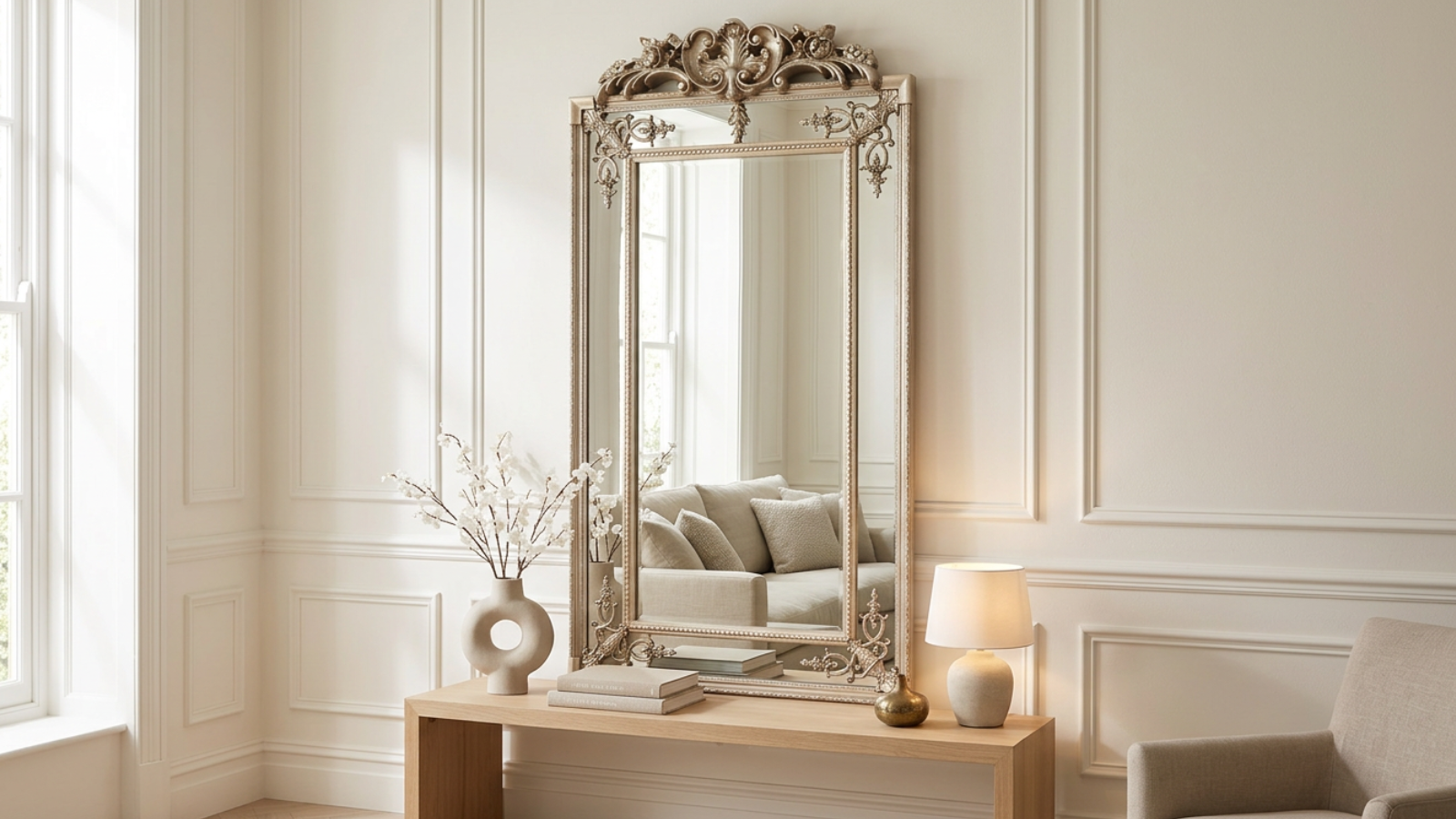
A wall mirror is one of the few decorative pieces capable of changing both how a room looks and how it feels.
The right mirror can reflect natural light into a darker corner, make a compact hallway appear more generous, introduce architectural character above a console table or create an elegant focal point within a living room. Unlike purely decorative artwork, a mirror interacts with the space around it, reflecting furniture, lighting and architectural details back into the room.
Yet choosing the right mirror involves more than selecting a frame you like.
Exploring different wall mirror styles side by side can make differences in scale, shape and frame detailing considerably easier to understand.
Scale matters. Shape matters. Placement matters. Even what the mirror reflects can determine whether it improves the room or introduces unnecessary visual clutter.
A mirror that is too small can feel insignificant against a large wall, while an oversized design can overwhelm surrounding furniture. A beautifully ornate frame may become the focal point in one room but compete with existing decorative details in another.
The most successful interiors treat mirrors as part of the architecture of the room rather than as an afterthought.
In this guide, we'll explore how to choose the perfect wall mirror for every room, including the right size, shape, frame and placement, along with the timeless principles interior designers use to reflect light, create balance and make spaces feel more considered.
A wall mirror should be chosen according to the scale of the wall, surrounding furniture and the effect you want to create. Larger mirrors can reflect more light and make rooms feel more spacious, while the right shape and frame help establish balance and complement the character of the interior.
16 min read
Why Mirrors Have Such a Powerful Effect on a Room
Mirrors are unusual because they influence both decoration and perception.
A sideboard, console or artwork occupies physical space. A mirror does something different: it visually extends the room beyond the wall itself.
Placed thoughtfully, a mirror can:
- Reflect natural daylight.
- Make narrow rooms feel more open.
- Introduce height.
- Create a strong focal point.
- Highlight architectural features.
- Balance furniture beneath it.
- Add decorative character through its frame.
This is why mirrors have remained such an important part of interior design for centuries.
Within traditional and Parisian-inspired interiors in particular, large mirrors have long been used to amplify beautiful architecture and light rather than simply providing a practical reflection.
The key is placement.
A mirror is only as beautiful as the view it reflects.
✦ Maison Jahvauns Editor's Note
Before deciding where to hang a mirror, stand in front of the proposed position and look behind you. Whatever you can see is likely to become part of the room twice. Whenever possible, reflect something worth seeing—natural light, artwork, architectural detailing or beautifully styled furniture.
How to Choose the Right Mirror Size
Scale is one of the most important considerations when choosing a wall mirror.
A mirror should feel proportionate to both the wall and any furniture positioned beneath it.
Too small, and it can appear as though it is floating without purpose. Too large, and it may visually overpower everything around it.
Mirrors Above Furniture
When positioning a mirror above:
- A console table.
- A sideboard.
- A fireplace.
- A chest of drawers.
consider the furniture and mirror as one composition.
The mirror will usually look most balanced when it is narrower than the furniture beneath it, rather than extending beyond both sides.
There isn't one rigid percentage that works in every interior because frame width, ceiling height and furniture proportions all influence the result.
Instead, aim for visual balance.
A substantial console often benefits from a generous mirror, while a smaller side table may require something more restrained.
Mirrors on Empty Walls
When a mirror isn't anchored by furniture, the surrounding architecture becomes more important.
Consider:
- Ceiling height.
- Doorways.
- Wall mouldings.
- Windows.
- Nearby artwork.
Large mirrors can work beautifully on tall or expansive walls, but they need sufficient breathing room around the frame.
Oversized Mirrors
Oversized mirrors can create tremendous impact.
They work particularly well in:
- Large hallways.
- Living rooms.
- Bedrooms.
- Dressing areas.
- Dining rooms.
The larger reflective surface also helps distribute natural light around the space.
However, oversized shouldn't mean disproportionate. The mirror should still feel connected to the architecture rather than simply filling an empty wall.
Round, Oval, Rectangular or Ornate: Which Mirror Shape Is Best?
The shape of a mirror can subtly change the character of the room.
Rather than choosing purely according to personal preference, consider the lines already present within the space.
Round Mirrors
Round mirrors soften rooms dominated by straight architectural lines.
They work particularly well above:
- Console tables.
- Smaller sideboards.
- Bathroom vanities.
- Compact hallway furniture.
Their curved shape creates contrast against rectangular furniture and wall panelling.
Round mirrors can also suit more contemporary interiors where a highly decorative frame might feel too formal.
For a more architectural interpretation of the round form, the Marin Extra-Large Porthole Round Accent Wall Mirror with Polished Aluminium Frame introduces a substantial circular silhouette with a cooler polished-metal finish.
Oval Mirrors
Oval mirrors offer similar softness while introducing greater vertical height.
They're particularly elegant in:
- Bedrooms.
- Dressing areas.
- Hallways.
- Traditional interiors.
Their elongated proportions can help draw the eye upwards, making them useful in rooms where you want to emphasise ceiling height.
A restrained design such as the Aurelia Oval Wall Mirror – Slim Gold Frame, 75cm demonstrates how an oval silhouette can introduce softness and vertical emphasis without overwhelming the surrounding furniture.
Rectangular Mirrors
Rectangular mirrors are perhaps the most versatile option.
They can feel:
- Architectural.
- Traditional.
- Minimal.
- Formal.
depending on their proportions and frame.
Large rectangular mirrors work particularly well above fireplaces, sideboards and substantial console tables where a stronger visual presence is required.
Ornate and Decorative Mirrors
With an ornate mirror, the frame becomes part of the artwork.
Carved detailing, gilded finishes and decorative crests can introduce considerable character even before the reflective glass is considered.
These mirrors work particularly well within:
- Parisian-inspired interiors.
- Period properties.
- Formal living rooms.
- Elegant bedrooms.
- Statement hallways.
Because the frame already contains visual detail, surrounding styling can often remain more restrained.
For a more expressive interpretation, the Valère Ornate Champagne Gilded Wall Mirror uses decorative framing and a warm gilded finish to turn the mirror itself into an architectural focal point
✦ Maison Jahvauns Editor's Note
When choosing a mirror shape, look at what the room already contains. If the architecture and furniture are dominated by straight lines, a curved mirror can introduce softness. If the room already contains curves, a stronger rectangular frame may provide the structure the composition needs.
Should You Choose Gold, Silver, Black or Natural Wood?
The frame influences how strongly the mirror participates in the overall colour palette.
Gold and Gilded Mirrors
Gold mirrors introduce warmth and decorative character.
They pair particularly well with:
- Warm timber.
- Cream walls.
- Linen upholstery.
- Brass lighting.
- Marble.
- Traditional mouldings.
Antique or champagne-toned gold finishes often feel softer and more timeless than highly polished yellow gold.
Silver Mirrors
Silver frames naturally introduce a cooler appearance.
They're particularly effective alongside:
- Grey interiors.
- Mirrored furniture.
- Cooler neutral palettes.
- Crystal lighting.
- Contemporary classic interiors.
Ornate silver frames can still feel traditional while creating a very different atmosphere from gilded designs.
Mirrored wardrobe doors offer another way to introduce a substantial reflective surface without requiring additional wall or floor space. Explore How to Choose the Perfect Wardrobe for Your Bedroom for guidance on mirrored wardrobes, storage configurations and bedroom placement.
Black-Framed Mirrors
Black mirrors introduce definition.
They work particularly well when the room needs stronger contrast or contains other dark architectural details.
Slim black frames suit contemporary interiors, while heavier frames can create a more dramatic effect.
Natural Wood Mirrors
Wood-framed mirrors introduce warmth and texture without relying on metallic finishes.
They're particularly appropriate within:
- Relaxed country interiors.
- Rustic schemes.
- Natural neutral spaces.
- Rooms containing substantial timber furniture.
The wood doesn't need to match surrounding furniture precisely. Similar undertones are usually enough to create harmony.
Where Should You Position a Wall Mirror?
A wall mirror should never be positioned simply because there happens to be an empty wall.
Consider what it will contribute.
Ask:
Will it reflect useful light?
Will it balance the furniture beneath it?
Will it create a focal point?
Will the reflection improve the room?
Once those questions are answered, placement becomes much easier.
How to Style a Mirror Above a Console Table
A mirror and console table are one of the most natural pairings in interior design.
Together, they create a complete vertical composition: the console anchors the arrangement at furniture level, while the mirror draws attention upwards and gives the wall a stronger sense of purpose.
This combination works particularly well in:
- Entrance halls.
- Living rooms.
- Dining rooms.
- Landings.
- Larger passageways.
The key is ensuring that the two pieces feel connected.
A small mirror positioned too far above a substantial console can appear disconnected. Equally, a very wide mirror above a narrow console may make the furniture beneath it seem undersized.
For a more considered result, centre the mirror over the console and allow enough space between the two pieces for decorative objects without creating a large visual gap.
Style the Console Around the Mirror
Once the mirror establishes the focal point, the console styling should support it rather than compete with it.
Try combining objects of different heights, such as:
A table lamp to introduce height and evening light.
A vase or sculptural object to create an additional vertical element.
A small stack of books to introduce a lower horizontal layer.
A decorative bowl or tray to provide a quieter finishing detail.
Avoid filling every available section of the console.
Negative space is important.
Leaving areas of the surface intentionally empty allows both the furniture and the mirror to retain their individual presence.
In more decorative interiors, an ornate mirror can provide much of the visual interest itself, meaning the console may require surprisingly little styling.
✦ Maison Jahvauns Editor's Note
Treat a console table and mirror as a single composition. Decide which piece should command the most attention first. If the mirror is highly ornate, keep the console styling restrained. If the mirror is simpler, the furniture and accessories can carry more of the decorative character.
How to Choose a Mirror Above a Sideboard
A mirror above a sideboard can transform an otherwise practical piece of storage furniture into a focal point.
This works especially well in dining rooms and living spaces, where the sideboard often occupies a long stretch of wall.
Because sideboards tend to be wider than console tables, scale becomes particularly important.
A very small mirror centred above a substantial sideboard can leave too much unused wall around it.
Instead, choose a mirror with enough presence to visually connect with the furniture beneath it.
This doesn't necessarily mean selecting the largest possible mirror.
A decorative oval mirror, for example, may occupy less horizontal space than a rectangular design while still commanding attention through its height and frame.
Consider the Entire Sideboard Composition
The mirror isn't the only element affecting the balance.
Objects placed on the sideboard also become part of the composition.
You might position:
- A lamp towards one side.
- A vase or arrangement of branches on the other.
- A decorative object closer to the centre.
- A restrained stack of books beneath a smaller accessory.
The mirror provides the visual centre while the accessories introduce variation around it.
Perfect symmetry isn't necessary.
In fact, slight asymmetry can make a carefully styled sideboard feel more relaxed and collected.
Choosing a Mirror for the Living Room
Living rooms often provide the greatest opportunity for a statement mirror.
Unlike a hallway mirror, which may need to perform a practical function, a living room mirror can be treated almost like a piece of architectural decoration.
The first question is where the room needs visual emphasis.
Possible positions include:
- Above a fireplace.
- Above a console table.
- Above a sideboard.
- Between windows.
- On a large uninterrupted wall.
- Leaning against a wall where appropriate and safely positioned.
A large mirror can also help balance substantial furniture such as sofas, bookcases and cabinets.
Mirrors Above Fireplaces
A fireplace naturally establishes a focal point.
Placing a mirror above it reinforces that hierarchy.
Traditional and ornate mirrors work particularly well here because the fireplace and mirror together can create an architectural centrepiece.
Pay attention to width.
The mirror shouldn't feel unrelated to the proportions of the fireplace beneath it.
Also consider what the mirror reflects from normal seating positions. A beautifully framed mirror that primarily reflects a blank ceiling may contribute less to the room than one positioned to capture a window, chandelier or attractive architectural detail.
Using a Mirror to Reflect a Window
One of the most effective mirror placements is opposite or adjacent to a source of natural light.
Rather than producing more daylight, the mirror redistributes the light already entering the room and can make the interior feel brighter and more open.
This can be especially effective in living rooms with:
- One principal window.
- Deep floor plans.
- Darker corners.
- Limited natural light.
However, don't position the mirror purely according to the window.
Check the complete reflection first.
You want to capture the light without unintentionally making cluttered or less attractive parts of the room more prominent.
Mirrors become equally interesting after daylight fades, when they can reflect table lamps, chandeliers and softly illuminated architectural details. Our guide to How to Layer Living Room Lighting Like an Interior Designer explores how these different sources can work together to create a more atmospheric room after dark.
Choosing a Mirror for the Dining Room
Dining rooms are particularly well suited to decorative mirrors.
Dining tables, sideboards and cabinets naturally introduce substantial horizontal furniture, while a wall mirror can create height and provide visual relief above them.
Mirrors can also interact beautifully with evening lighting.
Placed thoughtfully, they may reflect:
- Chandeliers.
- Pendant lights.
- Table lamps.
- Candles.
- Decorative table settings.
This can give the room greater depth after dark.
Above a Dining Room Sideboard
A sideboard is often the most natural location.
The sideboard creates a strong horizontal anchor, while the mirror provides the vertical focal point above it.
For traditional interiors, an ornate gold or silver mirror can make the arrangement feel more formal.
For quieter interiors, a simple round or rectangular frame may provide enough definition without competing with the dining table.
Don't Overfill the Dining Room Walls
Dining rooms frequently contain several visually significant pieces at once:
A large table.
Dining chairs.
A sideboard.
Lighting.
Possibly a display cabinet.
Potentially artwork as well.
Adding mirrors to every available wall can make the room feel unnecessarily busy.
One well-positioned statement mirror will usually create more impact than several smaller mirrors competing for attention.
✦ Maison Jahvauns Editor's Note
Consider your dining room mirror in both daylight and evening light. A position that seems understated during the day can become one of the room's most atmospheric features when it begins reflecting lamps, candles or a chandelier after dark.
Choosing a Mirror for the Bedroom
Bedroom mirrors need to balance practicality with atmosphere.
A bedroom should still feel restful, so mirror placement tends to benefit from greater restraint than in a hallway or formal living room.
Suitable positions can include:
- Above a chest of drawers.
- Above a dressing table.
- On an otherwise empty wall.
- Within a dressing area.
- As a full-length mirror positioned away from the bed.
Decorative mirrors can also provide an alternative to artwork above certain pieces of bedroom furniture.
When positioning a mirror near the bed, consider it as part of the wider composition formed by the bed, bedside furniture and lighting. Our guide to How to Choose the Perfect Bedside Table for Your Bedroom explains how height, scale and storage influence that arrangement.
Mirrors Above a Chest of Drawers
This follows many of the same principles as positioning a mirror above a console or sideboard.
The chest provides the visual anchor.
Choose a mirror that relates comfortably to its width and leave sufficient space for lamps or decorative accessories on the surface below.
A taller oval or rectangular mirror can be particularly effective where the room would benefit from additional vertical emphasis.
Mirrors can also become part of a dedicated dressing area rather than functioning independently. If you're planning one in your bedroom, How to Choose the Perfect Dressing Table for Your Bedroom explores how the table, mirror, seating, lighting and surrounding space can work together as a balanced composition.
Dressing Area Mirrors
Function becomes more important in a dressing area.
The mirror should provide a useful reflection while still feeling integrated with the surrounding furniture.
Consider lighting carefully.
Natural daylight from the side or front tends to provide a more useful reflection than strong light directly behind the person using the mirror.
The mirror should also respond to the room's principal furniture. If you're planning the bedroom from the bed outward, our guide to How to Choose the Perfect Bed for Your Bedroom explores scale, headboard proportions and furniture placement in greater detail.
Should You Put a Mirror Opposite the Bed?
There is no universal interior-design rule saying that a mirror cannot face a bed.
The more useful question is whether you enjoy seeing the reflection from the bed itself.
A large mirror directly opposite the bed can introduce significant movement and visual information into what would otherwise be a quiet part of the room.
For some interiors this works beautifully.
For others, it can make the bedroom feel less restful.
If you're uncertain, consider positioning the mirror:
- Beside the bed rather than directly opposite it.
- Above a chest of drawers on a side wall.
- Within a dedicated dressing area.
- At an angle where the bed doesn't dominate the reflection.
The objective isn't to follow an arbitrary rule.
It's to maintain the calm atmosphere a bedroom should provide.
In bedrooms, the furniture and objects surrounding a mirror also contribute to the overall composition. For a more detailed look at creating a calm arrangement beside the bed, read How to Style a Bedside Table Without Creating Clutter.
Choosing a Mirror for a Hallway or Entrance
Hallways are among the best places to use mirrors.
They are often:
- Narrow.
- Naturally darker.
- Limited in floor space.
- Dominated by doors and straight architectural lines.
A mirror can address several of these characteristics without occupying additional floor area.
Mirror Above a Hallway Console
For a larger hallway, a console table and mirror create an elegant arrival point.
The console provides somewhere for a lamp, vase or decorative tray, while the mirror introduces height and reflects light through the space.
A round mirror can soften a hallway containing numerous rectangular doorways.
A tall rectangular or oval mirror can instead emphasise ceiling height.
Mirrors in Narrow Hallways
In particularly narrow spaces, avoid overly deep frames or elaborate arrangements around the mirror.
The mirror itself may provide sufficient decoration.
A larger reflective surface can often feel calmer than a gallery-style arrangement of several small pieces.
This is an important distinction.
Making a small space feel considered doesn't necessarily mean filling it with small objects.
Sometimes one generous piece creates the greater sense of space.
Can Mirrors Make a Small Room Look Bigger?
Mirrors cannot physically increase the dimensions of a room, but they can change how those dimensions are perceived.
A mirror introduces visual depth because the eye reads the reflected space as an extension beyond the wall.
The effect is usually strongest when the mirror reflects:
- A window.
- An open doorway.
- A longer sight-line.
- A light-coloured section of the room.
- An uncluttered area.
Large mirrors generally create a stronger sense of expansion because they reflect a greater portion of the room.
However, placement matters more than size alone.
A huge mirror reflecting a cluttered corner may simply duplicate the clutter.
A moderately sized mirror reflecting a bright window can have a much more successful effect.
Use Mirrors to Extend Sight-lines
Consider the direction you naturally look when entering a room.
If a mirror is positioned at the end of that sight-line, the reflected image can make the room appear to continue further.
This technique can work particularly well in:
- Narrow hallways.
- Smaller dining rooms.
- Compact living rooms.
- Entrance areas.
The goal isn't to disguise the size of the room.
It's to make the available space feel lighter, more open and visually connected.
How High Should a Wall Mirror Be Hung?
There is no single correct height for every wall mirror.
The right position depends on:
- Mirror dimensions.
- Ceiling height.
- Furniture beneath it.
- Eye level.
- Frame shape.
- The reflection you want to capture.
For a standalone mirror, the central reflective area should generally feel comfortable to view rather than requiring you to look noticeably upwards or downwards.
When the mirror sits above furniture, however, its relationship with the furniture is usually more important than an arbitrary measurement from the floor.
Avoid Hanging the Mirror Too High
This is one of the most common placement mistakes.
When too much empty wall appears between a console, sideboard or chest and the mirror above it, the two pieces no longer feel visually connected.
The mirror appears to float independently.
Bringing it closer to the furniture creates a stronger composition.
You still need sufficient clearance for lamps, flowers or decorative objects, but there shouldn't be a large unexplained gap.
Consider the Frame, Not Just the Glass
A heavily ornamented frame can add considerable visual height and width.
Always judge the dimensions of the complete mirror rather than focusing only on the reflective glass.
This is especially important with:
- Rococo-inspired mirrors.
- Decorative crest mirrors.
- Wide gilded frames.
- Heavily carved designs.
The frame is part of the composition.
Should a Wall Mirror Be Vertical or Horizontal?
Many rectangular mirrors can create completely different effects depending on their orientation.
Hang a Mirror Vertically When You Want To:
Emphasise ceiling height.
Create a stronger full-length reflection.
Fill a narrow section of wall.
Introduce vertical balance beside lower furniture.
Make the room feel taller.
Hang a Mirror Horizontally When You Want To:
Emphasise the width of a console or sideboard.
Fill a broad section of wall.
Create a panoramic reflection.
Balance a long piece of furniture.
Make a composition feel more expansive.
The architecture should guide the decision.
A tall, narrow section of wall naturally suits vertical orientation, while a long sideboard may benefit from the broader visual line created by a horizontal mirror.
Common Mistakes When Choosing and Positioning Mirrors
Even a beautiful mirror can look wrong when its scale or placement doesn't relate to the room around it.
Avoiding a few common mistakes can make an enormous difference.
1. Choosing a Mirror That Is Too Small
This is particularly noticeable above substantial furniture.
A small mirror can appear lost above a wide sideboard, console or fireplace.
When uncertain between two appropriately proportioned sizes, the more generous option often creates the stronger focal point.
2. Hanging the Mirror Too High
A mirror should feel connected to the furniture or architectural feature beneath it.
Large gaps weaken that relationship.
3. Ignoring What the Mirror Reflects
This is perhaps the most overlooked mistake.
Don't evaluate a mirror only by looking directly at it.
Look into it.
If the dominant reflection is:
- A cluttered worktop.
- An unattractive doorway.
- A television.
- An unfinished corner.
- Another visually busy area.
consider changing its position.
4. Matching Every Metal Finish Exactly
A gold mirror doesn't require every lamp, handle and accessory in the room to be exactly the same shade of gold.
A carefully mixed interior often feels more natural.
Instead, look for compatible undertones and repeat finishes subtly elsewhere.
5. Using Too Many Statement Mirrors
A statement only works when there is something quieter around it.
Several large ornate mirrors within the same visual field can begin competing with one another.
Choose where you want the strongest focal point to be.
6. Forgetting the Furniture Beneath It
Never choose an above-furniture mirror in isolation.
Consider the complete composition:
Furniture + mirror + lighting + accessories + surrounding architecture.
These elements need to work together.
7. Following Trends Instead of the Room
Mirror trends change.
One year may favour irregular organic shapes; another may favour oversized arches or ultra-thin frames.
None of these is inherently wrong.
But the most enduring choice is usually the mirror that responds naturally to the architecture, furniture and character already present within the home.
✦ Maison Jahvauns Editor's Note
A timeless mirror doesn't have to be plain. Ornate frames, aged metallic finishes and unusual proportions can remain relevant for decades when they feel appropriate to the architecture around them. Longevity comes from coherence rather than simplicity alone.
How to Make a Wall Mirror Look More Expensive
The impression of luxury rarely comes from the mirror alone.
It comes from the composition around it.
One of the easiest ways to make a wall mirror feel more considered is to give it enough space.
Avoid surrounding an ornate mirror with numerous small decorative pieces.
Instead, allow the frame to breathe.
Then introduce a limited number of complementary materials elsewhere in the room.
For example:
Gilded mirror + warm timber + linen + ceramic + brass
or:
Silver mirror + pale wood + glass + soft grey upholstery
Repeated materials establish visual continuity without making the interior look overly coordinated.
Lighting also matters.
A table lamp positioned near a mirror can create a warm reflected glow in the evening, while natural daylight can emphasise the texture and detailing of an ornate frame during the day.
And perhaps most importantly, choose the correct scale.
A generously proportioned mirror in the right location will almost always feel more intentional than a small decorative mirror used simply to fill an empty wall.
Choosing a Mirror That Will Still Look Beautiful in Ten Years
A timeless mirror doesn't need to disappear into the background.
Some of the most enduring interiors contain highly decorative pieces.
What matters is whether the design has a reason to be there.
Look for:
- Balanced proportions.
- Materials that complement the room.
- Frames with convincing depth and texture.
- Shapes that respond to the surrounding architecture.
- A scale appropriate to the wall.
- A design you would choose independently of current trends.
Ornate gilded mirrors have existed in interiors for centuries.
Simple rectangular mirrors have done the same.
Round and oval mirrors are equally established forms.
This is why choosing according to the room rather than according to a momentary trend is so important.
A well-chosen mirror should feel as though it belongs to the home.
Not merely to the year in which it was purchased.
The Maison Jahvauns Principle
The best wall mirror does three things simultaneously:
It belongs to the architecture.
It improves the composition around it.
And it reflects something worth seeing.
When those three elements come together, a mirror becomes much more than a practical accessory.
It becomes part of how the room itself is experienced.
Common Wall Mirror Buying and Placement Mistakes
Even a beautifully designed mirror can feel wrong within a room if its scale, position or relationship with the surrounding furniture hasn't been considered carefully.
Avoiding these common mistakes will help ensure your mirror feels intentional rather than simply added to an empty wall.
Choosing a Mirror That Is Too Small
One of the most common mistakes is selecting a mirror that doesn't have enough visual presence for the wall or furniture beneath it.
A small mirror above a substantial console table, sideboard or fireplace can appear disconnected from the rest of the composition.
Before purchasing, consider the complete dimensions of the mirror—including the frame—and how they relate to the furniture and available wall space.
Hanging the Mirror Too High
A mirror positioned too far above the furniture beneath it can appear to float independently on the wall.
When placing a mirror above a console table, sideboard or chest of drawers, aim to create a clear visual relationship between the two pieces.
There should be sufficient room for lamps, flowers or decorative accessories, but not such a large gap that the composition becomes disconnected.
Ignoring What the Mirror Reflects
This is perhaps the most overlooked consideration.
A mirror doesn't simply occupy a wall—it duplicates whatever appears opposite it.
Before permanently installing one, consider whether it reflects:
- Natural light.
- Artwork.
- Architectural detailing.
- Beautiful furniture.
- An open doorway or attractive sight-line.
Equally, avoid positions where the dominant reflection is clutter, a television, utility equipment or another visually distracting area.
Matching Every Metal Finish Exactly
A gold mirror does not require every lamp, handle and decorative accessory in the room to have precisely the same finish.
Likewise, a polished metal or silver mirror can coexist comfortably with warmer materials elsewhere.
Subtle repetition is usually more sophisticated than exact matching.
Look for complementary undertones and allow a mixture of materials to give the room greater depth.
Using Too Many Statement Mirrors
An ornate or oversized mirror naturally attracts attention.
Several highly decorative mirrors within the same visual area can quickly begin competing with one another.
Decide where you want the strongest focal point and allow quieter elements elsewhere in the room to support it.
Forgetting About the Furniture Beneath It
Never choose a mirror above furniture in isolation.
Consider the complete arrangement:
Furniture + mirror + lighting + accessories + surrounding architecture.
A beautiful mirror can still feel poorly proportioned when it has no visual relationship with the furniture beneath it.
Choosing According to Trends Alone
Mirror trends will inevitably change.
Organic silhouettes, arches, minimal metal frames and heavily ornate designs may each move in and out of fashion.
Rather than choosing something simply because it is currently popular, look for a mirror whose scale, materials and character respond naturally to your home.
A design that belongs to the room is far more likely to remain beautiful for years to come.
✦ Maison Jahvauns Editor's Note
When choosing between two appropriately sized mirrors, don't automatically select the smaller option because it feels safer. A generously proportioned mirror often creates a calmer, more intentional focal point than a small piece surrounded by excessive empty wall.
Frequently Asked Questions
What size wall mirror should I choose?
The right size depends on the scale of the wall and any furniture positioned beneath the mirror.
Above a console table, sideboard or chest of drawers, choose a mirror with enough presence to feel visually connected to the furniture while generally remaining narrower than the piece beneath it.
For an empty wall, consider the proportions of the entire space rather than choosing according to the mirror alone.
Should a wall mirror be wider than the furniture underneath it?
Usually, a mirror above a console table or sideboard looks most balanced when it is narrower than the furniture beneath it.
This allows the furniture to visually frame the mirror.
However, proportions, mirror shape and frame design all influence the result, so this should be treated as a design principle rather than a rigid rule.
How high should a mirror be above a console table?
There is no single measurement that works for every room.
The mirror should sit close enough to the console that the two pieces appear as one composition while leaving enough clearance for table lamps, flowers and decorative accessories.
Avoid leaving a large unexplained gap between the furniture and mirror.
Are round or rectangular mirrors better?
Neither is universally better.
Round mirrors introduce softness and work particularly well in spaces dominated by straight architectural lines.
Rectangular mirrors provide greater structure and can complement substantial furniture such as fireplaces, sideboards and wider console tables.
The right choice depends on the architecture and proportions of the room.
Can mirrors make a small room look bigger?
Mirrors can make a small room feel larger by reflecting light, sightlines and parts of the surrounding space.
The effect is particularly successful when a mirror reflects a window, open doorway or uncluttered area.
Placement is often more important than size alone.
Should you put a mirror opposite a window?
A mirror positioned opposite or adjacent to a window can help redistribute natural light throughout a room and create greater visual depth.
Before installing it, check the complete reflection to ensure the mirror captures both the light and an attractive view of the interior.
Are ornate gold mirrors still in style?
Ornate gilded mirrors have been used in European interiors for centuries and are not dependent on a single decorating trend.
Their success depends largely on the surrounding room.
Within a restrained interior, an ornate gold mirror can provide an elegant focal point, while highly decorative surroundings may benefit from simpler styling around the mirror.
Can you mix gold and silver mirror finishes with other metals?
Yes.
Metal finishes do not need to match perfectly.
Gold, antique brass, silver and polished metal can work together when there is enough repetition elsewhere in the room to make the combination feel intentional.
This often creates a more layered and collected appearance than matching every metallic detail exactly.
Where should you avoid putting a mirror?
Avoid positions where the mirror primarily reflects visually distracting areas such as clutter, utility spaces or an unattractive doorway.
You should also consider glare and practical safety when installing large or heavy mirrors.
The best placement should improve both the appearance and functionality of the room.
Can you have too many mirrors in one room?
Yes.
Several large or highly decorative mirrors within the same room can compete for attention and create excessive visual movement.
In many interiors, one carefully positioned statement mirror will create greater impact than several smaller mirrors without a clear hierarchy.
Conclusion
Choosing the perfect wall mirror involves far more than finding a frame you like.
Scale, shape, placement, finish and reflection all influence whether the mirror feels naturally integrated into the room.
A round mirror may soften the architectural lines of a hallway.
An ornate gilded mirror can transform the space above a fireplace or console table.
A tall oval mirror may introduce elegance and vertical emphasis within a bedroom.
A substantial rectangular design might provide exactly the balance needed above a wide sideboard.
And a polished metal mirror can add architectural definition without overwhelming a more restrained interior.
There is no single mirror style that works everywhere.
Instead, begin with the room itself.
Consider the furniture and architecture already present, identify where additional light or visual balance would be valuable, and think carefully about what the mirror will reflect once installed.
Above all, avoid choosing according to short-lived trends alone.
The most successful mirrors feel as though they belong to the architecture and furniture surrounding them, creating an interior that remains coherent even as other decorative details evolve.
When chosen thoughtfully, a wall mirror becomes much more than somewhere to see your reflection.
It becomes part of the room's architecture—bringing light, depth, character and balance to the way the entire space is experienced.
Editorial Standards
Written by Shackeem — Founder & Furniture Curator, Maison Jahvauns
Maison Jahvauns was founded with a simple belief: exceptional furniture should be timeless, thoughtfully curated and designed to elevate the way we live. Every collection is personally selected by Shackeem, with a focus on refined craftsmanship, elegant proportions and enduring design inspired by Parisian interiors.
The Jahvauns Journal reflects the same philosophy. Every guide is written to help homeowners make informed furniture and interior design decisions through practical advice, timeless styling principles and carefully researched buying guidance. Rather than following short-lived trends, our articles are created to inspire elegant homes that remain beautiful for years to come.
Our Editorial Promise
Every article published in the Jahvauns Journal is independently written by Maison Jahvauns and reviewed for accuracy before publication. Our recommendations are based on timeless design principles, thoughtful furniture curation and a commitment to helping readers create refined interiors with confidence.
We regularly review and update our editorial content to ensure it remains relevant, accurate and valuable for our readers.
Last updated: 1 September 2026
Part of the Maison Jahvauns Journal — Curated guides for timeless interiors.
Continue Exploring Maison Jahvauns
Explore Our Wall Mirrors Collection
Discover carefully curated wall mirrors designed to introduce light, depth and architectural character throughout the home, from elegant gilded frames to round, oval and polished metal designs.
Browse Wall Mirrors
How to Style a Console Table Like an Interior Designer
Learn how to combine a wall mirror with lighting, decorative objects and beautifully proportioned furniture to create an elegant and balanced console table arrangement.
Read the Console Table Styling Guide
How to Choose the Perfect Sideboard for Every Home
Discover how to choose the right size, configuration and finish for a sideboard before completing the arrangement with lighting, accessories and a beautifully proportioned wall mirror.
Read the Sideboard Guide
How to Curate a Parisian Salon in Your Home
Explore how statement mirrors, timeless furniture, layered lighting and carefully chosen decorative objects come together within an elegant Parisian-inspired interior.
Read the Parisian Salon Guide
How to Choose the Perfect Coffee Table for Your Living Room
Continue building a balanced living room with our guide to selecting the right coffee table shape, size, material and proportions for your seating arrangement.
Read the Coffee Table Guide
Explore the Maison Jahvauns Lookbook
Discover curated interiors, timeless furniture and considered styling inspiration throughout the Maison Jahvauns Lookbook.
Explore the Lookbook
Trade & Commercial Projects
Maison Jahvauns supports interior designers, property developers, home staging companies and hospitality businesses with tailored quotations, curated furniture recommendations and personalised project support.
Explore Trade & Commercial