
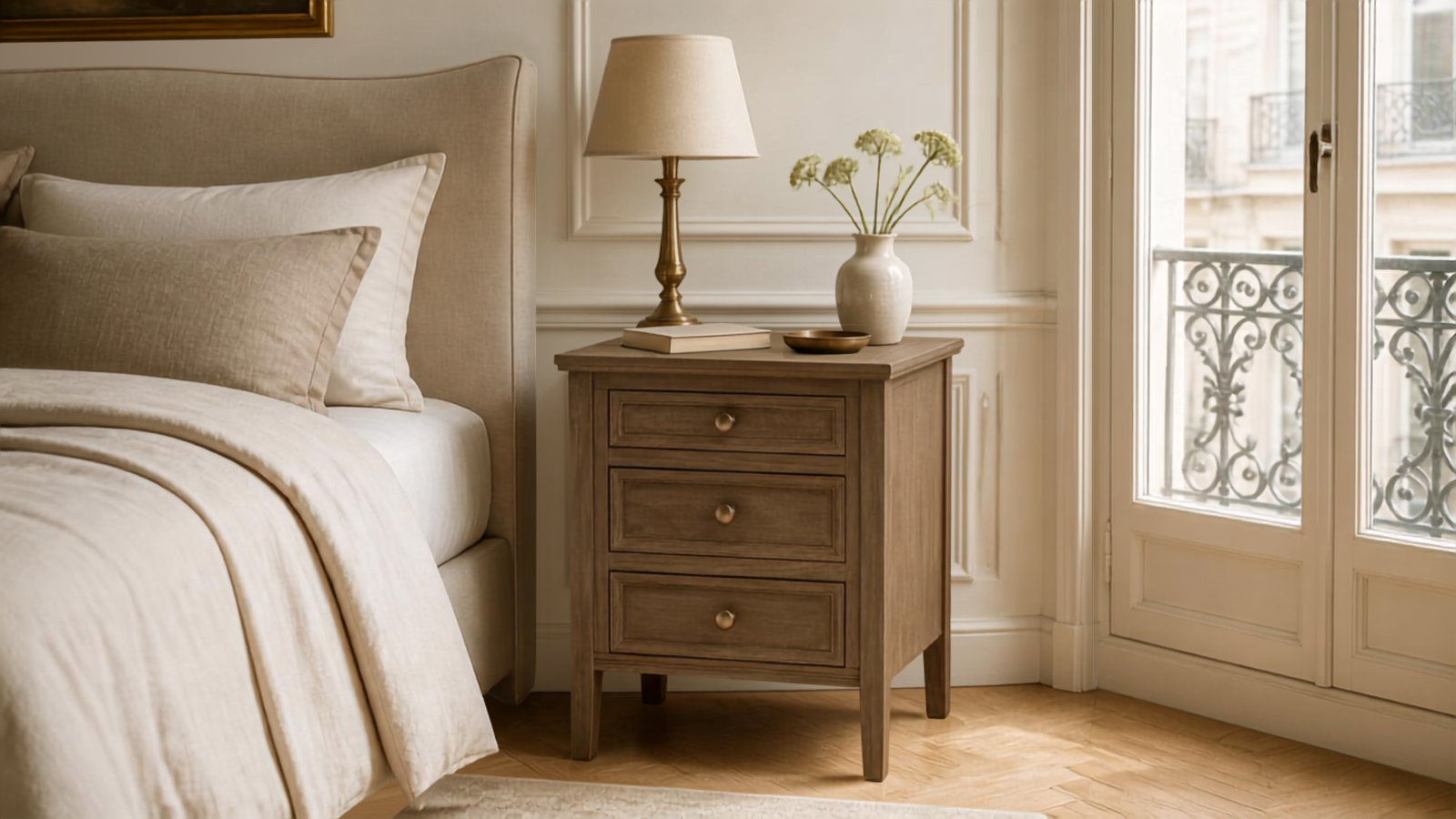
A bedside table may be one of the smallest pieces of furniture in a bedroom, yet it has an unusually important role. It sits immediately beside the bed, holds the objects we use at the beginning and end of each day, and often forms part of the first composition we notice when entering the room.
That combination of decoration and everyday function can make bedside tables surprisingly difficult to style.
Leave the surface almost empty and it can feel unfinished. Add too many books, candles, photographs, chargers and decorative objects and a once-elegant bedside quickly becomes cluttered.
The most successful bedside styling sits somewhere between the two.
Rather than trying to fill every available space, begin with the objects that genuinely need to be there, establish one or two strong visual elements and deliberately leave part of the surface unoccupied. The result should feel considered without appearing staged — and beautiful without becoming inconvenient to use.
How Do You Style a Bedside Table Without Clutter?
To style a bedside table without creating clutter, begin with a well-proportioned lamp, add only a few useful or meaningful objects at different heights and leave part of the surface deliberately empty. Use drawers, shelves or a small tray to contain everyday essentials so the bedside table remains practical while still feeling calm and considered.
Reading time: 15 minutes
Start With What Your Bedside Table Actually Needs to Do
Before adding decorative objects, consider how you use the space beside your bed.
Do you read before sleeping?
Do you need somewhere for glasses?
Do you keep a glass of water nearby?
Do you charge your phone overnight?
Does your bedside lamp provide reading light or simply create atmosphere?
The answers determine what genuinely deserves space on the table.
For many people, the essentials might be no more than:
- a bedside lamp
- a current book
- drinking water
- reading glasses
- a phone or charger
Anything beyond those objects should earn its place.
This is an important distinction because a bedside table is not the same as a console table or display shelf. It is a working piece of bedroom furniture.
Beautiful styling should make that function easier rather than compete with it.
Maison Jahvauns Editor's Note
A beautifully styled bedside table should still work effortlessly at eleven o'clock at night. If you have to move several decorative objects simply to put down a glass of water, the arrangement has become decoration at the expense of function.
Begin With the Bed, Not the Bedside Table
One of the easiest styling mistakes is treating the bedside table as an isolated surface.
Instead, step back and look at the entire composition:
bed + headboard + bedside table + lamp + surrounding wall
These elements are viewed together, so their proportions should relate to one another.
If you're refining the wider bedroom composition, How to Choose the Perfect Bed for Your Bedroom explores bed size, headboard proportions, placement and surrounding circulation in more detail.
A substantial upholstered or carved bed may make a very small lamp appear insignificant. Conversely, an oversized lamp on a delicate bedside table can overwhelm both the furniture and the surrounding bed.
The objective is not perfect mathematical symmetry.
It is visual balance.
This is why choosing the right bedside table in the first place matters so much. Height, width, storage and proportion all influence what can comfortably sit on its surface.
If you are still selecting the furniture itself, our guide to How to Choose the Perfect Bedside Table for Your Bedroom explores these considerations in greater detail.
Let the Bedside Lamp Establish the Composition
For most bedrooms, the lamp should be the first object positioned on the bedside table.
It provides height, creates a visual anchor and has an important practical role.
Rather than selecting a lamp purely because you like its design, consider how it relates to three things:
the bedside table,
the bed,
and the person using it.
A very narrow bedside table generally benefits from a more restrained lamp footprint so sufficient usable surface remains.
A wider table can accommodate a more substantial lamp without becoming crowded.
The height also matters.
If you regularly read in bed, sit against the pillows and consider where the light falls. The lamp should illuminate comfortably without leaving you staring directly into an exposed bulb or producing distracting glare.
From across the room, look at the lamp again.
Does it have enough presence beside the bed?
Does the lampshade feel proportionate to the headboard?
Does the lamp visually overwhelm the bedside table beneath it?
Practical testing is often more useful than following one universal measurement because bed heights, mattresses, headboards and bedside tables vary considerably.
Consider Wall Lighting When Surface Space Is Limited
A table lamp is not the only solution.
In smaller bedrooms, wall-mounted bedside lighting can free valuable surface space while still providing the layered evening illumination a bedroom needs.
This can be particularly effective when the bedside table is narrow.
Removing the lamp base creates room for everyday essentials while allowing the bedside arrangement to remain visually restrained.
Pendant lights positioned beside the bed can achieve a similar effect, although their placement should be carefully considered during the room-planning stage.
Whatever lighting method you choose, the principle remains the same:
the lighting should frame the bed rather than compete with it.
For a broader look at creating depth and atmosphere through multiple light sources, read How to Layer Living Room Lighting Like an Interior Designer. The same principles of ambient, task and accent lighting can be adapted throughout the home.
Create Different Heights Rather Than Adding More Objects
When a bedside arrangement feels flat, the instinct is often to add another accessory.
Usually, what is missing is not another object.
It is variation in height.
Imagine a bedside table containing a lamp, candle, small box and decorative bowl that are all approximately the same height. Even though the objects may be attractive individually, together they can create a horizontal line with very little visual rhythm.
Instead, build a simple hierarchy.
The lamp might provide the tallest element.
A small vase, framed photograph or sculptural object might occupy the middle level.
A book or shallow tray can provide the lowest.
The eye then moves naturally through the arrangement.
This is a useful principle throughout interior styling: variation creates interest more effectively than quantity.
Use Books With Restraint
Books are particularly well suited to bedside styling because they naturally belong in a bedroom.
But they are also one of the easiest sources of clutter.
A growing pile of half-read books can quickly consume the entire surface.
Instead, keep only the book you are currently reading nearby, or use a very small stack deliberately as part of the composition.
Two or three attractive hardbacks can create a low horizontal layer beneath a smaller object, but there is no need to manufacture a decorative book stack simply because you have seen one in an interiors photograph.
The best bedroom styling should feel connected to the person living there.
If you genuinely read at night, a book beside the bed feels natural.
If you do not, another object may be more appropriate.
Use a Tray to Give Small Objects a Home
Small objects often create more visual clutter than large ones.
Reading glasses, jewellery, a watch, lip balm and other everyday essentials can make a surface appear untidy even when there are relatively few things present.
A small tray or shallow dish can solve this by visually grouping them.
Instead of the eye seeing five unrelated objects scattered across the table, it sees one organised zone.
Choose a tray that occupies only a modest proportion of the surface. An oversized tray filled with accessories simply turns organised clutter into contained clutter.
A decorative box can perform the same function while concealing its contents completely.
The principle is simple:
small necessities should have a defined place rather than gradually spreading across the surface.
Make Use of Drawers and Closed Storage
If your bedside table includes a drawer, use it.
Not everything needs to become part of the styling.
Chargers, medication, hand cream, spare cables, tissues and other practical objects may be necessary, but they do not all need permanent positions on top of the furniture.
Keeping these items within easy reach but out of sight allows the surface to remain considerably calmer.
The same principle applies to the bedroom more broadly. If storage is becoming part of the wider room-planning decision, How to Choose the Perfect Wardrobe for Your Bedroom covers wardrobe size, internal configuration, doors and placement
This is one reason bedside tables with drawers can work particularly well for people who naturally accumulate more objects beside the bed.
Open shelves can also help, although they require slightly more discipline.
A shelf containing one or two books or a small storage basket can look considered.
A shelf filled with cables, paperwork and miscellaneous belongings will simply move the clutter down by thirty centimetres.
Deliberately Leave Empty Space
This may be the most important part of the entire arrangement.
You do not need to fill the bedside table.
Empty surface is not unfinished styling.
It is part of the styling.
Negative space allows individual objects to be appreciated and gives the entire bedside composition a quieter appearance.
It also serves a practical purpose.
Leave an accessible area near the bed where you can naturally place a glass, glasses, phone or book without rearranging the display first.
This small landing area makes the difference between a bedside table designed for a photograph and one designed for everyday life.
A useful test is to style the table and then remove one object.
Step back.
Very often, the arrangement becomes stronger.
Maison Jahvauns Editor's Note
Restraint is one of the simplest ways to make furniture feel more luxurious. Rather than asking what else could be added to an empty area, ask whether the empty area is what allows the objects around it to breathe.
Add One Personal or Decorative Element
Once the practical pieces are established, introduce something that gives the bedside table personality.
This might be:
- a small vase
- a single stem or restrained floral arrangement
- a framed photograph
- a candle
- a small sculpture
- a ceramic object
- a decorative box
- an object collected while travelling
One meaningful object is often more effective than several generic accessories.
The goal is not to recreate a showroom.
A bedroom is one of the most personal rooms in the home, and its styling should reflect that.
Objects with personal significance also help create the collected-over-time quality that prevents an interior from appearing overly coordinated.
Be Careful With Flowers and Greenery
Flowers can soften the straight lines of a bedside table and introduce an organic shape to the composition.
But scale matters.
Large bouquets can obstruct the lamp, overwhelm a small table or visually compete with the headboard.
A small vase containing a few stems is usually sufficient.
You might also consider seasonal branches, dried stems or another restrained natural element.
There is no requirement to include greenery at all.
If the arrangement already contains enough variation in shape, texture and height, adding flowers simply because a styling formula says you should may make the surface busier rather than better.
Hide Chargers and Cables Where Possible
Few things disrupt an otherwise elegant bedside arrangement faster than tangled charging cables.
If you charge devices beside the bed, consider how cables travel from the socket to the table.
Where possible, guide cables discreetly behind the furniture rather than allowing excess wire to gather across the surface.
A small cable clip can help keep a charging lead accessible without letting it fall behind the table each morning.
Bedside tables with rear openings, internal charging solutions or drawers can make this even easier.
The objective is not to pretend technology does not exist.
It is simply to stop it becoming the visual focal point.
Should You Keep Your Phone on the Bedside Table?
This is partly a lifestyle decision rather than an interior-design rule.
If your phone functions as your alarm or you need it nearby overnight, create a deliberate place for it.
A small stand, tray or clear section of surface prevents it from becoming another object floating around the arrangement.
If you prefer keeping technology away from the bed, charging the phone elsewhere has the additional design benefit of removing both the device and its cable from the bedside composition.
Either approach can work.
The important thing is intentionality.
How to Style a Small Bedside Table
Small bedside tables require greater editing rather than smaller versions of every accessory.
Begin with the essentials.
If a lamp occupies most of the surface, consider whether wall lighting would work better.
If you retain a table lamp, avoid surrounding it with several decorative objects.
One lamp, one book and sufficient clear space may be all that is needed.
Use drawers whenever available and move decorative elements to the wall instead.
Artwork above the bedside table, an elegant wall light or architectural detailing can provide visual interest without occupying valuable surface area.
This allows even a very compact table to feel intentional rather than under-styled.
How to Style a Bedside Table With an Open Shelf
An open shelf introduces another layer to the composition.
The temptation is to fill it.
Resist that temptation.
A restrained stack of books, one attractive storage box or a small basket may be sufficient.
Try to keep some visible space around whatever you place there.
The shelf should support the styling above rather than become a second display area competing for attention.
If you need substantial bedside storage, furniture with drawers or doors may ultimately suit your habits better than exposed shelving.
Should Both Bedside Tables Match?
Matching bedside tables create natural symmetry and are particularly effective when the bed is centred on a wall.
But matching furniture does not mean the styling on each side needs to be identical.
Two matching lamps can establish visual structure while the smaller objects differ.
One side might contain a book and small bowl.
The other might have a framed photograph or vase.
This creates balance without making the bedroom feel staged.
Alternatively, deliberately different bedside tables can work when their scale, height or materials create enough visual relationship.
The key is that the two sides should feel like part of the same bedroom rather than unrelated pieces accidentally positioned beside the same bed.
Do Both Bedside Lamps Need to Match?
No.
Matching lamps are an easy way to create symmetry, particularly in more formal or classically influenced bedrooms.
However, different lamps can create a more collected interior.
If using different designs, look for another connection between them.
That might be:
similar height,
related materials,
similar lampshade colours,
or comparable visual weight.
This creates cohesion without requiring exact duplication.
For Maison Jahvauns interiors, the choice depends on the character of the room. A grand French-inspired bed may look particularly elegant framed by matching lamps, while a softer collected bedroom may benefit from subtle variation.
Style Around the Headboard
A statement headboard already provides considerable visual interest.
The bedside styling should recognise that.
If the bed features deep upholstery, carved detailing or a dramatic silhouette, elaborate bedside arrangements can create unnecessary competition.
Simpler lamps and fewer accessories often allow the bed to remain the focal point.
Conversely, a restrained bed may accommodate more sculptural bedside lighting or stronger decorative objects.
Think of the bedroom as having a hierarchy.
Not every element needs to demand attention.
Usually, one should lead while the others support it.
Consider the Wall Above the Bedside Table
Surface styling is only part of the composition.
Artwork, wall lights, mirrors and architectural mouldings can all influence how much decoration the bedside table itself requires.
If you're considering a mirror as part of the composition, How to Choose the Perfect Wall Mirror for Every Room explains how scale, shape and placement can influence the balance of a space.
For example, a framed artwork positioned above the table may provide the middle layer of visual interest that would otherwise have been created using another object on the surface.
Likewise, a wall-mounted lamp removes the need for a table lamp altogether.
This is another reason to step back frequently while styling.
The correct question is not:
Does this bedside table need something else?
It is:
Does this part of the bedroom need something else?
Those are very different questions.
Mix Materials Rather Than Matching Everything
A beautifully considered bedside arrangement often contains subtle material contrast.
A wooden bedside table might be paired with a ceramic lamp, linen shade and small brass tray.
A painted table might sit beside an upholstered bed with glass, stone or metallic accents.
The materials do not need to match.
In fact, interiors often become more interesting when they do not.
Look instead for relationships in warmth, texture and visual weight.
Repeating a brass detail already found elsewhere in the room, for example, can create cohesion without making every item identical.
This approach helps a bedroom feel collected rather than purchased as one matching set.
Allow the Styling to Change
A bedside table does not need a permanent arrangement.
Flowers change with the seasons.
Books are finished and replaced.
A winter candle might disappear during summer.
A photograph or meaningful object may change over time.
Allowing these small details to evolve helps the bedroom remain personal.
The furniture provides the foundation.
The objects around it tell the story of the people living there.
That distinction is particularly important when creating a timeless interior.
Timeless does not mean static.
It means choosing a strong underlying composition that can accommodate gradual change.
The Maison Jahvauns Principle
Style the bedside table for the life that happens around it, not simply for the photograph.
Begin with proportion.
Give the lamp enough presence to relate to the bed.
Keep the things you genuinely use within reach.
Hide the things that do not need to be seen.
Introduce variation through height, texture and material rather than through quantity.
And most importantly, leave room.
Luxury rarely comes from filling every available surface. It comes from considered choices, beautiful proportions and the confidence to allow individual pieces to stand on their own.
A bedside table should feel calm because the bedroom itself should feel calm.
Common Bedside Table Styling Mistakes
Adding Too Many Decorative Objects
Candles, vases, books, photographs and ornaments may all look beautiful individually, but placing them together can quickly overwhelm a small surface.
Choose fewer pieces and give them more space.
Choosing a Lamp That Is Too Small
A tiny lamp beside a substantial bed can make the entire bedside arrangement feel under-scaled.
Consider the lamp in relation to the bed and headboard, not simply the tabletop.
Choosing a Lamp That Is Too Large
The opposite creates its own problem.
If the lamp consumes most of the table and leaves nowhere for everyday objects, the arrangement is no longer practical.
Filling Every Empty Space
An empty corner of the table does not automatically require another accessory.
Negative space creates visual calm and provides useful surface area.
Ignoring Everyday Habits
A perfectly styled table that has nowhere for your glasses, water or current book will quickly become messy.
Design around real routines.
Leaving Cables Exposed
Loose chargers and tangled wires introduce visual noise. Route or contain them wherever practical.
Creating Too Much Symmetry
Matching tables and lamps can look elegant, but duplicating every book, candle and decorative object on both sides can make the room feel overly staged.
Treating the Bedside Table in Isolation
Always assess the arrangement alongside the bed, headboard, lighting and wall behind it.
The whole composition matters more than the tabletop alone.
Frequently Asked Questions
What should you put on a bedside table?
A bedside table should primarily hold the things you genuinely use at night or in the morning, such as a lamp, book, water, glasses or phone. Add one or two decorative elements only if sufficient usable surface remains.
How many things should be on a bedside table?
There is no ideal number. The appropriate amount depends on the table's size and your needs. Rather than following a fixed rule, keep enough clear surface for everyday use and remove anything that makes the arrangement feel crowded.
How do I make my bedside table look less cluttered?
Remove objects that do not need to be there, store small necessities in drawers or a tray, conceal cables and leave part of the tabletop deliberately empty.
What is the best way to style a bedside table?
Start with the lamp or main visual anchor, then introduce one or two lower elements at different heights. Keep practical essentials accessible and maintain visible negative space around the arrangement.
Should bedside tables be higher or lower than the bed?
Bedside tables generally work best when their surface is reasonably close to the height of the mattress, making objects comfortable to reach. Small differences can work depending on the bed and furniture design.
How tall should a bedside lamp be?
There is no universal height because beds, mattresses and bedside tables vary. The lamp should feel proportionate to the furniture and provide comfortable illumination without exposing the bulb directly to your eye when sitting in bed.
Should bedside lamps match?
They do not have to. Matching lamps create symmetry, while different lamps can produce a more collected appearance if they share similar scale, materials, colour or visual weight.
Should bedside tables match each other?
No. Matching tables create an easy sense of balance, but complementary designs can also work when their height, scale, materials or overall character relate to one another.
What can I put on a bedside table instead of a lamp?
If you use wall lights or pendant lighting, the surface can instead hold a book, small vase, photograph, decorative box or other personal object while retaining plenty of clear space.
How do you style a very small bedside table?
Prioritise function. Use a compact lamp or wall-mounted light, keep decorative objects to a minimum and use drawers or nearby storage for everyday necessities.
Are books good for bedside table styling?
Yes, particularly when you genuinely read them. A current book or small stack can add height and personality, but large piles can quickly create clutter.
Should I put flowers on my bedside table?
Flowers are optional. A small arrangement can introduce softness and organic shape, but it should be proportionate to the table and should not obstruct lighting or usable surface space.
How do you hide chargers on a bedside table?
Route cables behind the furniture where possible, use small cable clips to keep leads controlled and store excess cable or charging accessories inside a drawer.
How do you make a bedside table look luxurious?
Focus on proportion, quality and restraint rather than quantity. A well-scaled lamp, tactile materials, one meaningful decorative piece and generous negative space can feel considerably more refined than a surface filled with accessories.
How do you style an open-shelf bedside table?
Keep the shelf simple. A small stack of books, storage box or basket is usually enough. Leaving some visible space prevents the lower shelf from making the overall arrangement appear crowded.
Conclusion
Styling a bedside table successfully is less about finding the perfect collection of decorative objects and more about understanding what to leave out.
Begin with function.
Consider the bedside table in relation to the bed and headboard, establish the composition with appropriately scaled lighting and introduce only a few objects that add genuine purpose, personality or visual interest.
Use drawers and trays to contain everyday necessities. Control cables rather than allowing them to dominate the surface. Vary height and material instead of increasing the number of accessories.
Then leave some space.
The most elegant bedside arrangements rarely feel as though they have been decorated according to a formula. They feel natural — as though every object happens to belong exactly where it has been placed.
That sense of effortless restraint is what allows a bedroom to feel calm, personal and beautifully considered.
Editorial Standards
Written by Shackeem — Founder & Furniture Curator, Maison Jahvauns
Maison Jahvauns was founded with a simple belief: exceptional furniture should be timeless, thoughtfully curated and designed to elevate the way we live. Every collection is personally selected by Shackeem, with a focus on refined craftsmanship, elegant proportions and enduring design inspired by Parisian interiors.
The Jahvauns Journal reflects the same philosophy. Every guide is written to help homeowners make informed furniture and interior design decisions through practical advice, timeless styling principles and carefully researched buying guidance. Rather than following short-lived trends, our articles are created to inspire elegant homes that remain beautiful for years to come.
Our Editorial Promise
Every article published in the Jahvauns Journal is independently written by Maison Jahvauns and reviewed for accuracy before publication. Our recommendations are based on timeless design principles, thoughtful furniture curation and a commitment to helping readers create refined interiors with confidence.
We regularly review and update our editorial content to ensure it remains relevant, accurate and valuable for our readers.
Last updated: 1 September 2026
Part of the Maison Jahvauns Journal — Curated guides for timeless interiors.
Continue Exploring Maison Jahvauns
Creating a beautifully considered bedroom begins with furniture that balances proportion, function and timeless design. Explore the Bedroom Retreats Collection for our curated selection of beds, bedside tables, wardrobes and complementary bedroom furniture.
If you're still choosing the furniture itself, read How to Choose the Perfect Bedside Table for Your Bedroom for detailed guidance on size, height, storage and proportion.
For the centrepiece of the room, discover How to Choose the Perfect Bed for Your Bedroom, including advice on bed size, headboard proportions, placement and surrounding circulation.
And if you're planning bedroom storage, our guide to How to Choose the Perfect Wardrobe for Your Bedroom explores wardrobe dimensions, internal configuration, doors and placement.