
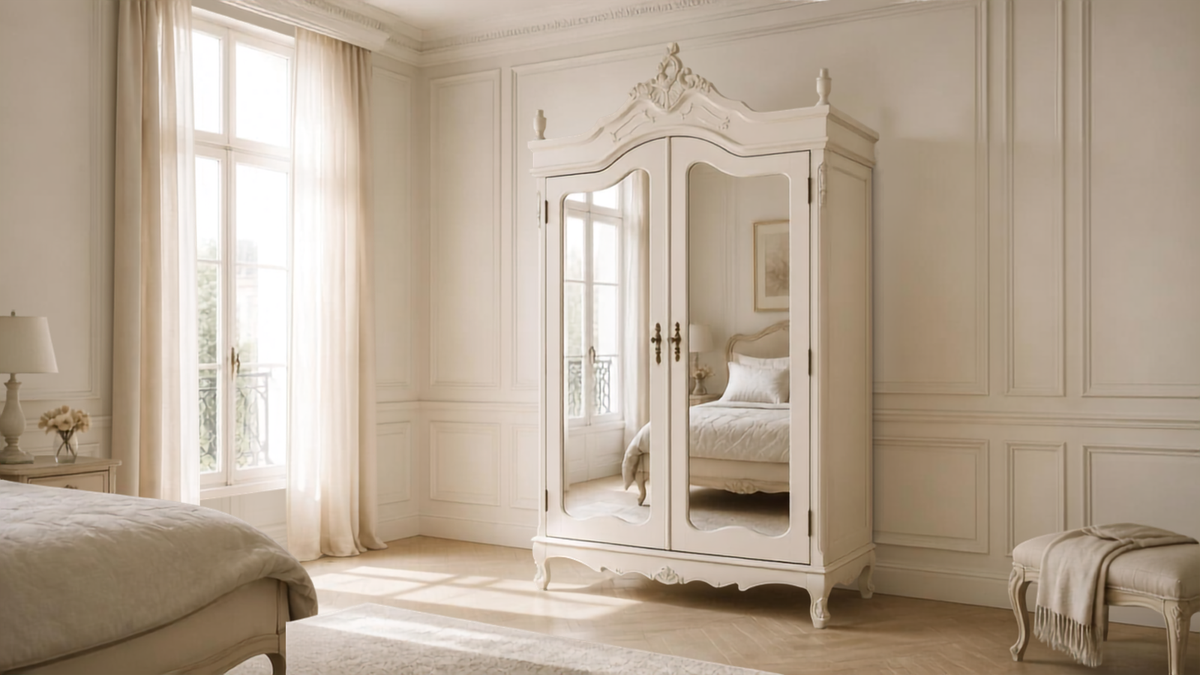
A wardrobe has one of the most demanding roles of any piece of bedroom furniture.
It needs to provide enough storage for the clothes and belongings you actually own, fit comfortably within the architecture of the room, allow its doors and drawers to operate properly and contribute to the overall character of the bedroom.
And because wardrobes are usually among the tallest and most substantial pieces of furniture in the room, mistakes in scale are difficult to disguise.
A wardrobe that is too small may leave you short of useful storage while looking visually insignificant against a large wall.
One that is too wide can restrict circulation or overwhelm the bed.
A wardrobe that appears to fit perfectly according to its width may prove impractical once there isn't enough room to open the doors.
And choosing the largest wardrobe available doesn't necessarily solve the problem. Storage capacity depends just as much on internal configuration as external size.
The right wardrobe therefore isn't simply the one with the greatest dimensions.
It is the one that provides the right combination of hanging space, shelving, drawers, proportions and accessibility for your particular bedroom.
There are aesthetic decisions too.
Should the wardrobe match the bed?
Would mirrored doors make the room feel lighter?
Should you choose a double, triple or larger wardrobe?
Is a freestanding wardrobe preferable to fitted storage?
And how should a substantial armoire or decorative wardrobe be positioned without competing with the bed?
In this guide, we'll explore how to choose the right wardrobe size, how much depth you need, the differences between common wardrobe configurations, internal storage planning, door clearance, mirrored wardrobes, freestanding versus fitted designs and how to choose a wardrobe that feels naturally connected to the rest of your bedroom.
Choose a wardrobe by measuring the available width, height and depth of your bedroom, then consider the clothes and belongings you need to store. Compare hanging space, shelves and drawers as well as the wardrobe's external dimensions, and allow sufficient clearance for doors, drawers and comfortable movement around the room.
17 min read
✦ Maison Jahvauns Editor's Note
Measure the wardrobe's complete external dimensions and its usable internal storage. Two wardrobes of similar size can provide very different amounts of hanging and folded storage depending on their internal configuration.
Start With What You Actually Need to Store
Before measuring walls or comparing wardrobe designs, look at what the wardrobe needs to contain.
This is one of the easiest steps to overlook.
You can compare different wardrobe, bed and bedside-table proportions throughout our curated Bedroom Retreats collection, designed to help create cohesive and practical sleeping spaces.
People often choose a wardrobe based on the number of doors it has, assuming that a larger exterior automatically means more useful storage.
But the internal arrangement matters just as much.
Consider how much of your clothing needs:
- Full-length hanging.
- Short hanging.
- Shelving.
- Drawers.
- Shoe storage.
- Accessory storage.
- Occasional or seasonal storage.
Someone who owns mostly shirts, jackets and folded knitwear has different requirements from someone storing long dresses and coats.
A wardrobe filled primarily with shelves won't be particularly useful if most of your clothing needs to hang.
Likewise, a large uninterrupted hanging compartment may waste space if much of your wardrobe is folded.
The first question should therefore be:
What does this wardrobe actually need to hold?
Once you understand that, comparing furniture becomes considerably easier.
Measure the Available Space Properly
A wardrobe isn't simply a rectangle placed against a wall.
Its surroundings affect whether it works.
Measure the available:
Width
Determine the horizontal wall space available without interfering with doors, windows, curtains, radiators or other furniture.
Height
Measure from the finished floor to the ceiling and consider coving, cornices, beams, sloping ceilings or picture rails.
Depth
Check how far the wardrobe can project into the bedroom before circulation becomes restricted.
Then look beyond those three basic dimensions.
Consider:
- Skirting boards.
- Electrical sockets.
- Light switches.
- Radiators.
- Window openings.
- Curtain stacks.
- Door frames.
- Uneven walls.
- Architectural mouldings.
A wardrobe may technically fit the measured wall while still conflicting with one of these details.
Period properties deserve particular care because walls, floors and ceilings aren't always perfectly square.
Measure in more than one place where necessary.
Don't Forget the Space in Front of the Wardrobe
One of the most common wardrobe-planning mistakes happens outside the wardrobe rather than inside it.
The furniture fits beautifully against the wall.
Then the doors cannot open comfortably.
Hinged wardrobe doors require clear space in front of them.
Drawers require additional space when fully extended.
And you still need somewhere to stand while using them.
Consider the complete operating zone:
wardrobe → open door or drawer → person → surrounding furniture.
If the bed sits directly opposite, measure the distance between the two pieces.
Ask whether you can comfortably open the wardrobe while someone moves around the bed.
This becomes especially important in smaller bedrooms.
A few centimetres gained by choosing a shallower or narrower wardrobe can sometimes make a disproportionate improvement to how the room functions.
How Deep Should a Wardrobe Be?
Wardrobe depth is determined partly by what needs to hang inside it.
Clothing hanging conventionally on a rail requires enough internal depth for hangers and garments to sit naturally without being compressed against the doors.
But external depth also includes:
- The doors.
- Back panel.
- Frame.
- Decorative mouldings.
- Handles or projections.
This means usable internal depth and overall external depth aren't necessarily the same measurement.
Always check the manufacturer's specifications where available.
A very shallow wardrobe may occupy less bedroom space but compromise conventional hanging storage.
A deeper wardrobe may provide excellent internal capacity while projecting too far into a narrow room.
The correct depth is therefore a balance between usable storage and available circulation space.
How Wide Should a Wardrobe Be?
There is no ideal wardrobe width.
The right measurement depends on both storage requirements and the scale of the bedroom.
A narrow wardrobe may provide enough storage for a guest bedroom or someone with relatively modest hanging requirements.
A wider wardrobe can accommodate more varied storage and may feel better proportioned against a substantial wall.
But don't choose width solely according to available wall space.
Consider what happens beside the wardrobe.
Does it leave enough breathing room between itself and a doorway?
Does it crowd the bed?
Does it make another piece of furniture appear squeezed into the remaining gap?
Furniture generally looks more intentional when there is some visible space around it.
Filling an entire wall simply because the dimensions allow it can make freestanding furniture feel more like an improvised fitted installation.
How Tall Should a Wardrobe Be?
Tall wardrobes can make excellent use of vertical space.
They can also provide useful upper storage for belongings that aren't required every day.
But height affects visual weight.
A wardrobe approaching ceiling height will naturally have greater architectural presence than a lower piece.
In a room with generous ceilings, this can create an elegant sense of scale.
In a smaller room with a low ceiling, the same piece may feel imposing.
Also consider what happens above the wardrobe.
Leaving visible wall space can make freestanding furniture feel more distinct and allow decorative cornicing or mouldings to remain visible.
A taller design may maximise storage but create a more fitted visual effect.
Neither is automatically preferable.
The right choice depends on whether your priority is maximum storage, visual lightness or architectural presence.
Double, Triple or Larger Wardrobe?
The number of doors provides a useful shorthand when comparing wardrobes, but it shouldn't be your only measure of capacity.
Double Wardrobes
A two-door wardrobe can be ideal for smaller bedrooms, guest rooms or more focused storage requirements.
Its relatively compact width also makes it easier to position around doors, windows and other bedroom furniture.
If you're also planning a dedicated area for getting ready, How to Choose the Perfect Dressing Table for Your Bedroom explains how to compare dressing table size, storage, seating, mirrors, lighting and placement within the wider bedroom layout.
But check the internal layout.
A well-designed double wardrobe can sometimes provide more useful storage than a larger piece with an arrangement that doesn't suit your belongings.
Triple Wardrobes
Three-door wardrobes often provide greater flexibility.
The additional section might contain:
- Extra hanging space.
- Shelves.
- Internal drawers.
- Separate short and long hanging.
This can make a triple wardrobe particularly useful when different types of clothing need to be stored together.
Its additional width, however, needs to be balanced against the surrounding room.
Four-Door and Larger Wardrobes
Larger wardrobes can provide substantial storage and may reduce the need for additional bedroom furniture.
That can sometimes make a room feel calmer overall.
One generous wardrobe may be preferable to a smaller wardrobe combined with several separate storage pieces.
But larger wardrobes have much greater visual presence.
They require sufficient wall width, circulation space and room scale to feel deliberate rather than dominant.
More doors should mean more useful storage—not simply more furniture.
✦ Maison Jahvauns Editor's Note
Don't compare wardrobes by door count alone. Open the specification or product images and map what each internal section would actually contain. A carefully configured double wardrobe may suit your belongings better than a poorly configured triple.
Hanging Space vs Shelving
One of the most important internal decisions is how much hanging space you genuinely require.
Long hanging is useful for:
- Dresses.
- Long coats.
- Longer garments.
Short hanging can accommodate:
- Shirts.
- Blouses.
- Jackets.
- Trousers folded over hangers.
- Shorter coats.
Where the wardrobe allows two shorter rails to be positioned vertically, the same width can potentially accommodate significantly more hanging clothing than one full-height rail.
Shelves are useful for:
- Knitwear.
- Jeans.
- Folded clothing.
- Bags.
- Storage boxes.
- Bedding.
The right balance depends entirely on your belongings.
Don't choose a wardrobe because the empty interior looks spacious.
Imagine your actual clothing inside it.
That is a much more useful measure of capacity.
Do You Need Drawers Inside the Wardrobe?
Internal drawers can reduce the need for a separate chest of drawers.
This can be particularly valuable in smaller bedrooms where floor space is limited.
They might hold:
- Underwear.
- Socks.
- Accessories.
- Nightwear.
- Folded clothing.
Consolidating storage into one substantial wardrobe can create a calmer furniture layout.
But internal drawers also consume space that could otherwise be used for hanging or shelving.
If you already own a chest of drawers that works beautifully within the room, dedicating large amounts of wardrobe space to drawers may be unnecessary.
Again, think about the bedroom as a complete storage system rather than evaluating each piece independently.
Freestanding vs Fitted Wardrobes
Both can work beautifully, but they create very different relationships with the room.
Freestanding Wardrobes
A freestanding wardrobe behaves as an individual piece of furniture.
This allows more flexibility.
It can:
- Move with you.
- Be repositioned.
- Introduce a contrasting material.
- Become a decorative feature.
- Create a more collected interior.
Freestanding furniture is particularly suited to rooms where you want individual pieces to contribute character.
The visible space around and sometimes beneath the furniture also helps establish it as an object within the room.
Fitted Wardrobes
Fitted wardrobes can maximise difficult spaces and use more of the available wall height and width.
They can be particularly practical in rooms with alcoves or where maximum storage is the overriding priority.
Their appearance is more architectural.
Rather than reading as individual furniture, they often become part of the room itself.
The choice therefore isn't simply about storage.
Ask whether you want the wardrobe to behave as furniture or architecture.
When Does an Armoire Work Better Than a Conventional Wardrobe?
An armoire can turn storage into a decorative feature.
Traditionally inspired armoires often have stronger architectural detailing than conventional wardrobes, with features such as:
- Decorative cornices.
- Panelled doors.
- Shaped bases.
- Carved details.
- Mirrored fronts.
- Distinctive hardware.
They can work particularly well in bedrooms where the wardrobe will remain highly visible rather than being hidden within an alcove.
But a decorative armoire needs breathing space.
Placing it tightly between several other pieces can diminish the details that make it distinctive.
Consider the wall around it and what sits nearby.
If the bed is already highly ornate, a decorative armoire may need to be quieter.
If the bed is relatively restrained, the wardrobe can carry more of the room's visual character.
The two pieces should establish a hierarchy rather than compete for attention.
Should You Choose a Mirrored Wardrobe?
Mirrored wardrobe doors can perform several functions simultaneously.
If you're considering additional mirrors elsewhere in the room, our guide to How to Choose the Perfect Wall Mirror for Every Room explores scale, shape, placement and reflection in greater detail.
They provide a full-length reflection, reduce the need for a separate standing mirror and reflect light and surrounding architecture back into the room.
This can be particularly useful in bedrooms where wall or floor space is limited.
A mirror can also reduce the perceived visual solidity of a large wardrobe because part of its surface reflects the room rather than presenting an uninterrupted material finish.
The Élodie Mirrored Double Door Armoire Wardrobe in White Finish demonstrates this balance particularly well, combining enclosed bedroom storage with mirrored doors that can introduce light and visual depth without requiring a separate full-length mirror.
But placement matters.
Before choosing mirrored doors, consider what they will reflect.
A beautiful window, bed or architectural feature can create depth.
A cluttered doorway or awkward corner may simply become twice as noticeable.
The question isn't only:
“Do I want a mirrored wardrobe?”
It is:
“What will this mirror show me every day?”
If you prefer a non-mirrored wardrobe, a separate wall mirror can provide the same practical reflection while allowing greater flexibility in placement.
Can a Large Wardrobe Work in a Small Bedroom?
Yes—but only when its storage value justifies its footprint.
A larger wardrobe can sometimes make a small bedroom less cluttered, particularly if it eliminates the need for additional chests, rails or storage furniture.
This is an important distinction.
Small rooms don't necessarily need small furniture everywhere.
They need efficient furniture.
One substantial wardrobe with excellent internal storage may create a cleaner room than several undersized pieces scattered around it.
However, the wardrobe must still preserve:
- Comfortable circulation.
- Door clearance.
- Access to other furniture.
- Natural light.
- Visual balance.
If it overwhelms the architecture or makes the room difficult to navigate, its storage capacity isn't enough to justify it.
Wardrobe placement should also be considered as part of the complete furniture plan rather than in isolation. How to Arrange Bedroom Furniture for a Balanced, Elegant Room explores how wardrobes, beds, bedside tables and dressing areas can be positioned while maintaining comfortable circulation and visual balance.
Where Should a Wardrobe Be Positioned?
The best location usually combines accessible storage with a relatively quiet architectural position.
Consider whether the wardrobe:
- Blocks natural light.
- Crowds a window.
- Interferes with curtains.
- Restricts the bedroom door.
- Competes with the bed.
- Creates an awkward narrow passage.
- Blocks electrical sockets.
- Prevents other furniture from opening.
A wardrobe doesn't always need to occupy the largest empty wall.
Wardrobe placement should also respond to the bed, which usually remains the principal focal point of the room. Our guide to How to Choose the Perfect Bed for Your Bedroom explores bed size, circulation, positioning and furniture hierarchy in greater detail.
Sometimes a slightly smaller wall produces a better overall layout because the wardrobe becomes less dominant.
Think about the view from the bedroom entrance too.
If the first thing visible is the side of a very deep wardrobe, the room can immediately feel smaller.
Where possible, position substantial furniture so its front elevation contributes to the room rather than its depth dominating the view.
Should the Wardrobe Match the Bed?
No.
The wardrobe and bed don't need to come from the same collection or use exactly the same finish.
The same principle applies to smaller bedroom furniture. Our guide to How to Choose the Perfect Bedside Table for Your Bedroom explains how bedside tables can relate to the bed through proportion, material and detailing without requiring an exact match.
In many interiors, some variation creates greater depth.
A painted wardrobe can sit with an upholstered bed.
A natural timber wardrobe can work beside painted bedside tables.
A mirrored armoire can introduce a more decorative element to an otherwise restrained furniture scheme.
Look for smaller relationships instead.
These might include:
- Similar hardware finishes.
- Related timber undertones.
- Repeated curves.
- Similar levels of decorative detail.
- Colours already present elsewhere.
If both the bed and wardrobe are highly decorative, allow the surrounding furniture to become quieter.
If one is the clear statement piece, the other can support it.
A successful bedroom needs relationships between furniture, not compulsory matching.
Explore our bedroom furniture collection to see how wardrobes, beds, bedside tables and mirrors can be combined through complementary proportions, finishes and details.
Think About Wardrobe Colour and Visual Weight
Colour can substantially change how large a wardrobe appears.
Light painted finishes can help a substantial piece relate more softly to pale walls.
Natural timber introduces warmth and grain, which can make a large surface visually richer.
Darker finishes create stronger contrast and may give the wardrobe greater presence.
Mirrored surfaces break up visual solidity through reflection.
None of these is universally better.
Consider the relationship between the wardrobe and the wall behind it.
High contrast makes the furniture more noticeable.
Lower contrast can help it integrate more quietly into the room.
If the wardrobe is already large and decorative, a softer tonal relationship may prevent it from becoming overwhelming.
If the design is simple, greater contrast can help give it definition.
Consider the Wardrobe From Across the Room
Wardrobes are usually viewed from farther away than we realise.
You may see the piece:
- From the bed.
- Through the bedroom doorway.
- Reflected in a mirror.
- From an adjoining dressing area.
Step back when evaluating its proportions.
Does it feel appropriately scaled against the wall?
Is there enough visible space around it?
Does its height relate comfortably to the ceiling?
Does it compete with the headboard?
Does the room now contain too many large pieces fighting for attention?
The best bedroom furniture arrangements aren't judged one product at a time.
They are judged as compositions.
A wardrobe should contribute to the bedroom's overall sense of balance rather than feel like a separate storage solution. For a wider perspective on combining elegant furniture with practical storage, How to Create a Luxury Bedroom That Never Goes Out of Style explores how thoughtful proportions, coordinated materials and restrained decoration can create a calm, cohesive space.
Don't Forget Delivery Access
Wardrobes present some of the same delivery challenges as substantial beds—and sometimes greater ones.
Before ordering, determine whether the wardrobe arrives:
- Fully assembled.
- Partially assembled.
- Flat-packed.
- In separate sections.
Then consider the complete route into the bedroom.
Measure:
- External doors.
- Internal doors.
- Hallways.
- Staircases.
- Landings.
- Tight corners.
- Ceiling clearance.
A tall rigid wardrobe section can be particularly difficult to manoeuvre on a staircase or landing.
Also remember that a wardrobe sometimes needs additional ceiling clearance to be raised from horizontal into its final upright position.
Don't assume that because the wardrobe's finished height fits beneath the ceiling, it can automatically be assembled or raised in that space.
The Maison Jahvauns Principle
A wardrobe should solve the bedroom's storage problem without becoming a new spatial problem.
Begin with what you own.
Decide what needs to hang, what should be folded and what would benefit from drawers or shelving.
Then measure the room—not simply the empty wall.
Account for the wardrobe's complete width, height and depth.
Allow its doors and drawers to operate.
Protect circulation.
Check its relationship with the bed, windows and other furniture.
Only then should appearance become the deciding factor.
A large wardrobe can work beautifully in a smaller bedroom when it consolidates storage efficiently.
A decorative armoire can become an architectural feature when it has enough space to breathe.
Mirrored doors can introduce reflection and reduce the perceived solidity of substantial furniture when their placement is considered carefully.
And the wardrobe doesn't need to match the bed.
What matters is that the pieces share enough visual relationships to belong within the same room while maintaining a clear hierarchy.
The best wardrobe isn't necessarily the largest.
Nor is it the one with the greatest number of doors.
It is the one where the internal storage suits your belongings, the external proportions suit your bedroom and the design contributes to the room without compromising how comfortably it works.
Common Wardrobe Buying and Bedroom Planning Mistakes
A wardrobe can appear relatively straightforward to choose: measure the available wall, select the required number of doors and decide which design you prefer.
In practice, some of the most frustrating wardrobe problems occur because the furniture has been considered only as a closed object rather than as something that needs to function within the room every day.
The right wardrobe must work internally, externally and spatially.
Avoiding these common mistakes can make the difference between simply adding storage and creating a bedroom that feels genuinely better organised.
Measuring Only the Available Wall Width
Width is important, but it is only one part of the calculation.
A wardrobe also has height and depth, and those dimensions can affect the bedroom just as significantly.
Check ceiling height, coving, skirting boards, sockets, switches and architectural details before deciding that a particular wall is suitable.
Most importantly, consider how far the wardrobe will project into the room.
A piece can fit perfectly across the wall while still making the surrounding space uncomfortable to navigate.
Forgetting About Door Clearance
A hinged wardrobe doesn't occupy only its closed footprint.
Its doors need somewhere to go.
Measure the space required for them to open comfortably and consider whether they will collide with:
- The bed.
- Bedside tables.
- A bedroom door.
- A chest of drawers.
- Other wardrobe doors.
- Nearby furniture.
The same applies to external drawers.
The furniture isn't genuinely suitable unless you can use all of it comfortably.
Choosing by Door Count Alone
Two doors, three doors and four doors provide a convenient way of describing wardrobes, but they don't tell you exactly how useful the storage will be.
A triple wardrobe isn't automatically better than a double.
Look inside.
Compare hanging rails, shelves, drawers and separate compartments.
The wardrobe with fewer doors may actually suit your belongings better.
Assuming Bigger Always Means Better Storage
External volume doesn't necessarily translate into efficient storage.
A large wardrobe with one uninterrupted hanging rail might provide less useful capacity for your particular clothing than a smaller design combining hanging, shelving and drawers.
Think in terms of usable storage rather than furniture size.
Not Auditing Your Clothes Before Buying
Choosing the internal layout without understanding what you own often leads to wasted space.
If most of your clothing is folded, prioritising extensive long hanging makes little sense.
If you own many dresses or coats, shelves alone won't solve the problem.
Take a realistic inventory before deciding what the wardrobe needs to provide.
Ignoring Wardrobe Depth
Depth is easy to overlook because product photography generally emphasises the front of the furniture.
A deep wardrobe can project considerably into a bedroom.
This is particularly noticeable when positioned opposite the bed or near a doorway.
Conversely, an unusually shallow wardrobe may compromise conventional hanging space.
Always assess internal usefulness against external projection.
Filling an Entire Wall Automatically
A large uninterrupted wall can make an enormous wardrobe tempting.
But freestanding furniture often benefits from visible space around it.
Leaving some wall exposed can make the wardrobe appear more deliberate and allow architectural features to remain visible.
Don't fill a wall merely because you can.
Choosing Several Small Storage Pieces Instead of One Efficient Wardrobe
Small bedrooms don't always benefit from small furniture.
A compact wardrobe combined with a chest, additional rail and storage cabinet can create more visual and physical clutter than one larger, well-configured wardrobe.
Consider the total furniture footprint required to solve the storage problem.
Sometimes one substantial piece is the more efficient choice.
Matching the Entire Bedroom Suite
A matching wardrobe, bed, bedside tables and chest can create immediate consistency, but it isn't compulsory.
Furniture can relate through proportion, colour, hardware, timber tone or decorative detailing without belonging to the same collection.
Some variation can make the bedroom feel more naturally assembled over time.
Ignoring What Mirrored Doors Will Reflect
Mirrored wardrobes can increase light and create a greater sense of depth.
But mirrors repeat whatever faces them.
Before buying, stand where the wardrobe will sit and look directly across the room.
That is approximately what the mirrored doors will reflect.
Consider whether the view is one you actually want emphasised.
Positioning a Large Wardrobe Where Its Side Dominates the Entrance
A wardrobe may look beautiful from the front while presenting a substantial blank side panel from another angle.
This is especially important near bedroom entrances.
If possible, avoid layouts where the first view into the room is dominated by the depth of a large wardrobe.
Forgetting About Delivery and Assembly
A wardrobe fitting into its final position doesn't mean it can necessarily reach that position.
Check how the furniture arrives and whether its largest components can navigate doors, stairs, landings and corners.
If assembly takes place inside the bedroom, make sure there is sufficient working and ceiling clearance.
✦ Maison Jahvauns Editor's Note
Before ordering, mark the wardrobe's complete footprint on the floor and its height and width on the wall. Then mark the arc of any hinged doors. Open the bedroom door, walk around the bed and use nearby furniture normally. This reveals far more than checking the wardrobe dimensions against an empty wall.
Frequently Asked Questions
How do I choose the right wardrobe for my bedroom?
Start by assessing what you need to store and how much hanging, shelving and drawer space you require.
Then measure the available width, height and depth within the bedroom, accounting for doors, windows, radiators, skirting boards and surrounding furniture.
Finally, compare the wardrobe's internal configuration and external proportions rather than choosing by appearance or door count alone.
What size wardrobe do I need?
The right wardrobe size depends on the amount and type of clothing you need to store and the space available within the bedroom.
Choose enough capacity to meet your storage requirements without compromising circulation, door clearance or the proportions of surrounding furniture.
How deep should a wardrobe be?
A wardrobe should be deep enough for its intended hanging and storage configuration while remaining appropriate for the room.
Check both the usable internal depth and complete external depth, as doors, frames, handles and decorative mouldings can increase the overall projection.
How wide should a wardrobe be?
There is no universal ideal width.
The wardrobe should provide sufficient storage while leaving enough surrounding space for comfortable circulation and other furniture.
Avoid automatically filling an entire wall simply because the dimensions permit it.
How tall should a wardrobe be?
Tall wardrobes can maximise vertical storage, but the appropriate height depends on ceiling height, room scale and whether you want the furniture to feel freestanding or more architectural.
Consider coving, mouldings and any clearance required for assembly.
Is a double wardrobe big enough?
A double wardrobe can be sufficient for a guest bedroom, smaller clothing collection or carefully planned storage arrangement.
The internal configuration matters more than the number of doors, so check how much hanging, shelving and drawer space the particular wardrobe provides.
Is a triple wardrobe better than a double wardrobe?
Not necessarily.
A triple wardrobe generally provides more space, but it is only better if its internal arrangement suits your belongings and its additional width works comfortably within the bedroom.
A well-configured double can sometimes be the more practical choice.
Is a four-door wardrobe too big for a bedroom?
It depends on the room.
A four-door wardrobe can work well in a sufficiently large bedroom or even a smaller room where it consolidates several storage requirements into one piece.
It becomes too large when it restricts circulation, overwhelms the architecture or interferes with other furniture.
Should I choose a wardrobe with shelves or hanging space?
Choose according to your clothing.
Long garments require full-height hanging, while shirts and jackets may work with shorter hanging sections. Knitwear, jeans and folded clothing benefit from shelving.
Many people will find a combination of both most useful.
Are wardrobe drawers useful?
Yes, particularly when they reduce the need for a separate chest of drawers.
They can provide convenient storage for underwear, accessories, nightwear and folded clothing.
However, drawers occupy space that might otherwise provide hanging or shelving, so consider your overall storage requirements.
Is a freestanding or fitted wardrobe better?
Neither is universally better.
Freestanding wardrobes provide flexibility and can contribute character as individual pieces of furniture.
Fitted wardrobes can maximise available wall and ceiling space and work particularly well where storage capacity or awkward architecture is the priority.
Are mirrored wardrobes good for small bedrooms?
They can be.
Mirrored doors reflect light and the surrounding room and can reduce the perceived visual solidity of a large wardrobe.
They can also eliminate the need for a separate full-length mirror.
Consider carefully what the mirrors will reflect before choosing their position.
Should a wardrobe match the bed?
No.
A wardrobe can differ from the bed in material, colour and design while still feeling cohesive.
Look for relationships through hardware, timber undertones, shapes, colours or similar levels of decorative detailing instead of requiring an exact match.
Where should a wardrobe be positioned in a bedroom?
Choose a position that provides easy access without blocking natural light, windows, curtains, doors or circulation.
Also consider the view from the bedroom entrance and whether the wardrobe's depth or visual weight dominates the room unnecessarily.
Can a large wardrobe work in a small bedroom?
Yes, if it uses space efficiently and eliminates the need for several additional storage pieces.
The wardrobe must still leave adequate circulation, door clearance and access to surrounding furniture.
A large but efficient wardrobe can sometimes make a small bedroom feel calmer than several smaller storage pieces.
What is the difference between an armoire and a wardrobe?
Both provide enclosed clothing storage, but the term armoire is commonly associated with a freestanding, often more decorative piece of furniture with greater architectural or traditional detailing.
The exact internal configuration varies by design, so storage should still be assessed individually.
How do I know if a wardrobe will fit upstairs?
Check the complete delivery route, including external and internal doors, hallways, stairs, landings, ceiling heights and tight turns.
Find out whether the wardrobe arrives assembled, partially assembled or in separate sections before ordering.
Conclusion
Choosing the perfect wardrobe begins with something you won't see once the furniture is installed:
understanding what needs to go inside it.
Start with your clothes and belongings.
Work out what needs long hanging, what needs shorter hanging, what you prefer to fold and whether drawers would reduce the need for another piece of bedroom furniture.
Only then should you begin comparing wardrobe sizes.
Measure the room carefully.
Check width, height and depth.
Account for skirting boards, corn-icing, windows, radiators and doors.
Then go one step further and consider the space the wardrobe needs while being used.
Doors need to open.
Drawers need to extend.
You need somewhere to stand.
The bed and surrounding furniture still need to remain accessible.
These practical considerations are what distinguish a wardrobe that merely fits from one that genuinely belongs in the room.
Size should also be judged intelligently.
A smaller bedroom doesn't automatically require the smallest wardrobe.
One substantial, efficiently configured piece may provide a calmer result than several smaller storage solutions occupying different areas of the room.
Likewise, a large bedroom doesn't necessarily need an enormous wardrobe simply because the wall can accommodate one.
Allow furniture to breathe.
Then consider appearance.
A mirrored armoire can reflect light and architecture while reducing the perceived solidity of a substantial piece.
Natural timber can introduce warmth.
Painted finishes can relate more quietly to the walls.
Decorative wardrobes can become statement pieces when given enough surrounding space.
And none of these needs to match the bed exactly.
The most interesting bedrooms often contain furniture that relates rather than repeats.
A handle may echo the finish of a lamp.
A timber undertone might connect with the floor.
A curve in the wardrobe could respond subtly to the shape of the headboard.
These small relationships create cohesion without requiring a matching suite.
Ultimately, the best wardrobe isn't defined by how many doors it has.
It is defined by how effectively it uses the space inside the furniture and around it.
When storage capacity, accessibility, proportion and design all work together, the wardrobe stops feeling like a large box placed against a wall.
It becomes part of the architecture and rhythm of the bedroom—providing the storage everyday life requires while allowing the wider room to remain calm, balanced and considered.
Editorial Standards
Written by Shackeem — Founder & Furniture Curator, Maison Jahvauns
Maison Jahvauns was founded with a simple belief: exceptional furniture should be timeless, thoughtfully curated and designed to elevate the way we live. Every collection is personally selected by Shackeem, with a focus on refined craftsmanship, elegant proportions and enduring design inspired by Parisian interiors.
The Jahvauns Journal reflects the same philosophy. Every guide is written to help homeowners make informed furniture and interior design decisions through practical advice, timeless styling principles and carefully researched buying guidance. Rather than following short-lived trends, our articles are created to inspire elegant homes that remain beautiful for years to come.
Our Editorial Promise
Every article published in the Jahvauns Journal is independently written by Maison Jahvauns and reviewed for accuracy before publication. Our recommendations are based on timeless design principles, thoughtful furniture curation and a commitment to helping readers create refined interiors with confidence.
We regularly review and update our editorial content to ensure it remains relevant, accurate and valuable for our readers.
Last updated: 10 October 2026
Part of the Maison Jahvauns Journal — Curated guides for timeless interiors.
Continue Exploring Maison Jahvauns
Explore Our Wardrobes
Discover carefully curated wardrobes and armoires combining practical bedroom storage with elegant proportions, distinctive materials and timeless design.
Browse Wardrobes
Explore Bedroom Retreats
Discover beds, bedside tables, wardrobes, mirrors and complementary furniture curated for calm and considered bedrooms.
Explore Bedroom Retreats
How to Choose the Perfect Bed for Your Bedroom
Learn how bed size, frame dimensions, headboard proportions, placement and circulation can help create a beautifully balanced sleeping space.
Read the Bed Buying Guide
How to Choose the Perfect Bedside Table for Your Bedroom
Discover how to choose bedside furniture with the right height, width, storage and proportions for your bed and surrounding space.
Read the Bedside Table Guide
How to Choose the Perfect Wall Mirror for Every Room
Explore how mirror size, shape, placement and reflection can influence light, proportion and the wider furniture composition of your bedroom.
Read the Wall Mirror Guide
Furniture Verdict
Unsure whether a particular wardrobe will suit the scale or character of your bedroom? See a selected Maison Jahvauns piece visualised within your own room before deciding.
Discover Furniture Verdict
Explore the Maison Jahvauns Lookbook
Discover curated interiors, timeless furniture and considered styling inspiration throughout the Maison Jahvauns Lookbook.
Explore the Lookbook
Trade & Commercial Projects
Maison Jahvauns supports interior designers, property developers, home staging companies and hospitality businesses with tailored quotations, curated furniture recommendations and personalised project support.
Explore Trade & Commercial