
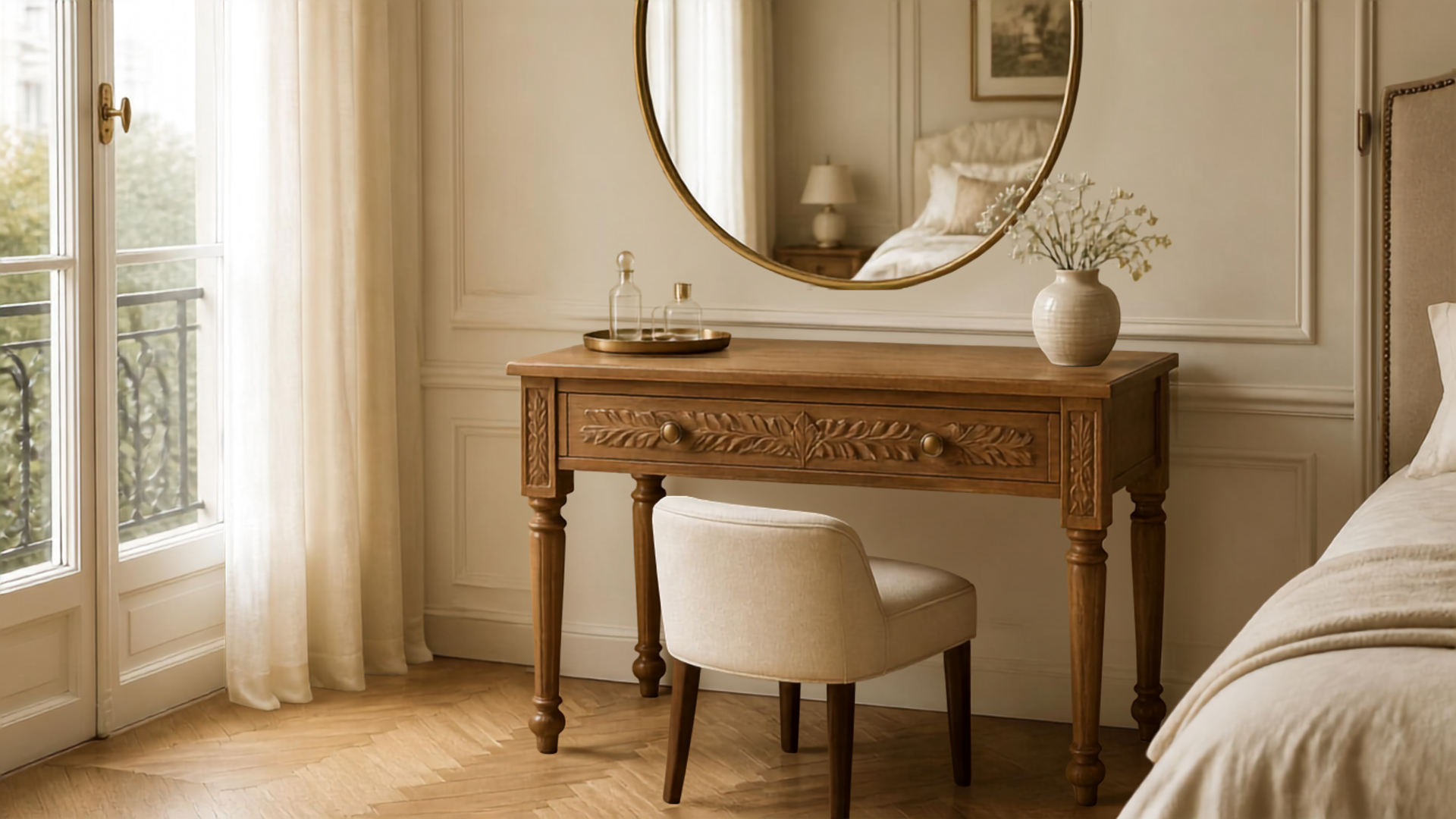
A dressing table can transform a bedroom in a way that extends far beyond providing somewhere to get ready.
At its most practical, it creates a dedicated place for cosmetics, jewellery, skincare and everyday essentials. Visually, however, a well-chosen dressing table can also introduce balance to an empty wall, provide an elegant setting for a mirror and lighting, and give the bedroom another layer of character beyond the bed and wardrobe.
The difficulty is choosing one that genuinely belongs in the room.
A dressing table that is too large can restrict movement and make a bedroom feel crowded. One that is too small may provide little useful storage or become visually lost beside more substantial furniture. Poor placement can make drawers difficult to open, leave insufficient room for a stool or position the mirror where the lighting is least flattering.
The right dressing table should therefore be chosen in much the same way as any important piece of bedroom furniture: begin with the room, understand how you will use it and then consider the design.
How Do You Choose the Right Dressing Table?
Choose a dressing table by measuring the available width and depth of your bedroom, allowing enough space for a chair or stool and comfortable movement behind it. Consider the storage you need, where the mirror and lighting will sit, and choose proportions and materials that complement the bed and surrounding furniture without overcrowding the room.
Reading time: 16 minutes
Start With How You Will Use the Dressing Table
Before considering finishes, handles or decorative details, decide what the dressing table actually needs to do.
For one person, it may primarily be somewhere to sit while applying make-up.
For another, it might hold jewellery and perfume.
Someone else may need substantial drawer storage for cosmetics, hair tools and skincare.
And in a smaller home, the dressing table may occasionally need to function as a compact writing or laptop surface as well.
These different uses require different furniture.
Ask yourself:
- Will you sit at it every day?
- What needs to be stored inside it?
- Do you need a large mirror?
- Will you use hair or beauty appliances that require nearby sockets?
- Do you need room for a stool or upholstered chair?
- Will objects remain permanently on the surface?
- Could the table occasionally serve another purpose?
This prevents you from choosing furniture based entirely on appearance and discovering later that it does not accommodate your routine.
Maison Jahvauns Editor's Note
A dressing table should make the bedroom easier to live in. The most beautiful design will quickly become frustrating if drawers cannot accommodate what you use or there is nowhere comfortable to sit.
Measure the Available Space Before Choosing the Furniture
The width of the dressing table is only one measurement that matters.
You also need to consider its depth and the space required in front of it.
Begin by measuring the wall or area where you intend to position the furniture.
Then consider nearby:
- doors
- wardrobes
- drawers
- radiators
- windows
- bedside furniture
- electrical sockets
- circulation routes
A dressing table positioned beside a wardrobe, for example, should not prevent the wardrobe doors from opening fully.
Likewise, placing one close to the bedroom entrance should not create an obstacle every time someone enters the room.
Marking the approximate footprint on the floor with removable tape can be useful when judging whether a larger piece will feel comfortable before purchasing it.
Don't Forget the Chair or Stool
This is one of the easiest measurements to overlook.
The dressing table may fit perfectly against the wall while leaving insufficient room to actually sit at it.
You need space for the chair or stool itself and additional clearance behind it so it can be pulled out comfortably.
How much room is required will depend on the furniture and layout, so rather than relying on one universal measurement, recreate the position using an existing dining chair or stool if possible.
Sit down.
Pull the chair backwards.
Stand up.
Walk behind it.
If every movement feels restricted before the furniture has even arrived, the arrangement is probably too tight.
In compact bedrooms, a stool that tucks almost completely underneath the dressing table can be particularly useful.
Consider the Height of the Dressing Table
Most dressing tables are designed around seated use, but their heights can vary.
The important relationship is between:
table height + seat height + available legroom
A beautifully proportioned table can still be uncomfortable if the chair places you too high or too low.
If the dressing table includes a deep drawer beneath the top, check the clearance beneath it as well.
This is particularly important if you intend to use an upholstered chair rather than a low dressing-table stool.
When purchasing the table and seating separately, compare their dimensions rather than assuming any chair will fit comfortably underneath.
How Wide Should a Dressing Table Be?
There is no single ideal width.
A compact dressing table may be appropriate for a smaller bedroom where the objective is to create a dedicated getting-ready area without dominating the wall.
A wider design can provide greater storage and surface space in a larger room.
The important question is proportion.
A very small dressing table positioned along a broad empty wall can appear visually insignificant.
A very wide table squeezed between a wardrobe and window can make the bedroom feel overfurnished.
Consider the surrounding architecture and furniture rather than the measurement in isolation.
The dressing table should occupy its area confidently while still leaving enough visual and physical space around it.
How Deep Should a Dressing Table Be?
Depth matters because dressing tables are often positioned along bedroom walls where circulation is important.
A deeper surface provides more room for storage and everyday objects, but it also projects further into the room.
This can become particularly noticeable in narrow bedrooms or where the dressing table sits opposite the bed.
When comparing designs, consider what genuinely needs to sit on the surface.
If most cosmetics and accessories can be stored inside drawers, you may not require an especially deep tabletop.
A shallower dressing table can sometimes provide all the function required while preserving considerably more floor space.
Choose Storage Around What You Actually Own
Storage configuration deserves as much attention as the external appearance.
Before buying, consider what will live inside the dressing table.
Small drawers can be useful for:
jewellery,
cosmetics,
make-up brushes,
hair accessories,
and smaller personal items.
Deeper drawers may be better suited to larger bottles, hair tools and other bulky necessities.
A dressing table with one drawer may be entirely sufficient for someone with a restrained routine.
Someone with a larger collection of cosmetics or accessories may quickly outgrow it.
The objective is not necessarily to purchase the dressing table with the most storage.
It is to purchase the one with the right storage.
Drawers Help Keep the Surface Calm
Closed storage has another advantage: it protects the appearance of the room.
A dressing table naturally attracts small objects.
Perfume bottles, jewellery, brushes, make-up, skincare and hair accessories can gradually spread across the tabletop until the furniture feels more like storage than part of an elegant bedroom.
Drawers allow everyday necessities to remain nearby without requiring them to become permanent decoration.
This follows the same principle we use when styling smaller bedroom surfaces: what needs to be accessible does not necessarily need to be visible.
If maintaining calm surfaces is important to you, prioritise furniture with enough concealed storage for your routine.
Decide Whether You Need a Mirror
A dressing table does not technically require a mirror, but for many people the two naturally belong together.
The first decision is whether the mirror should:
- sit directly on the table
- attach to the furniture
- hang independently on the wall
- or form part of a larger vanity arrangement
A freestanding tabletop mirror offers flexibility and can be moved easily.
A wall-mounted mirror preserves more usable surface area and can create a stronger visual composition.
Large decorative mirrors can also turn the dressing table into a focal point within the bedroom.
Whichever approach you choose, make sure the mirror is positioned at a comfortable height when seated rather than selecting its position solely according to how it looks while standing.
Choose the Mirror in Proportion to the Dressing Table
A tiny mirror above a substantial dressing table can appear disconnected.
An enormous mirror above a delicate table may visually overwhelm it.
Look at the two pieces as a single composition.
The mirror does not necessarily need to match the width of the furniture beneath it, but there should be a clear proportional relationship between them.
Round and oval mirrors can soften the horizontal and vertical lines of a rectangular dressing table.
Rectangular or more decorative framed mirrors can create a stronger architectural statement.
The correct choice depends on the character of the furniture and the wider bedroom.
The goal is relationship rather than exact matching.
For more detailed guidance on mirror size, shape and positioning throughout the home, read How to Choose the Perfect Wall Mirror for Every Room.
Think Carefully About Natural Light
Natural light can make a significant difference to how pleasant a dressing area is to use.
Where possible, consider positioning the dressing table somewhere that benefits from daylight.
But directly facing a bright window is not always ideal.
Strong light behind you can leave your face in shadow when looking into the mirror, while direct sunlight can create glare.
Soft daylight arriving from the front or side can often provide a more comfortable arrangement.
Observe how light moves through the bedroom at the time of day when you are most likely to use the dressing table.
A position that looks perfect at midday may behave very differently early in the morning.
Add Lighting for Evenings and Darker Mornings
Natural light cannot be relied upon throughout the year, particularly in UK bedrooms during winter.
A dressing area therefore benefits from suitable artificial lighting.
A decorative table lamp can provide atmosphere, but it may not always provide the even illumination required for applying make-up or grooming.
Wall lighting positioned around the mirror can offer a more practical solution where the room allows it.
Whatever lighting you choose, avoid creating harsh glare directly in the mirror.
Think about lighting as both practical and atmospheric.
The dressing table forms part of the bedroom, so its lighting should support the calm character of the room rather than making the area feel disconnected from it.
Position the Dressing Table Near Electrical Sockets Where Practical
If you regularly use a hairdryer, straighteners or other electrical appliances, socket position deserves consideration before deciding where the dressing table will go.
An elegant arrangement can quickly become inconvenient if extension cables need to stretch across the room.
Where possible, keep the dressing area within comfortable reach of an existing socket while ensuring cables can be controlled safely and discreetly.
Do not allow socket position to dictate the entire bedroom layout, but include it as one of the practical factors when comparing possible locations.
Should a Dressing Table Go Under a Window?
It can.
Positioning a dressing table beneath a window may make excellent use of an otherwise empty wall and provide abundant natural light.
However, there are trade-offs.
You may not be able to position a large wall mirror directly above the furniture.
Curtains may interfere with the tabletop.
Radiators are also frequently positioned beneath bedroom windows.
And depending on the direction of the room, direct sunlight may create glare.
If the arrangement works practically, a dressing table beneath a window can be beautiful.
It simply requires more consideration than placing the furniture against a conventional wall.
Can a Dressing Table Go at the End of the Bed?
In a sufficiently large bedroom, yes.
A dressing table positioned opposite or beyond the foot of the bed can create a distinct dressing area and make use of a larger room.
But circulation becomes especially important.
There should still be a comfortable route around the foot of the bed when the dressing-table chair is being used.
If the table causes the central walkway to narrow significantly, the room may begin to feel crowded regardless of how attractive the furniture is.
This arrangement generally works best when the bedroom already has generous floor space.
Where Should a Dressing Table Go in a Small Bedroom?
Small bedrooms require the dressing table to earn every centimetre it occupies.
Look first for underused areas:
a short section of wall,
an alcove,
space beneath a window,
or an area that might otherwise hold purely decorative furniture.
A compact dressing table with drawers can provide both a getting-ready surface and useful storage.
Choosing seating that tucks underneath it helps preserve circulation when the furniture is not being used.
Wall-mounted lighting and mirrors can also free valuable tabletop space.
Most importantly, resist the temptation to choose a miniature version of every piece of furniture.
A small bedroom often feels calmer with fewer appropriately scaled pieces than with many undersized ones.
Maison Jahvauns Editor's Note
Small rooms do not need small versions of everything. They need furniture that justifies the space it occupies. A well-chosen dressing table providing surface, storage and a dedicated daily function can be more valuable than several smaller pieces serving no clear purpose.
Dressing Table or Desk: Which Should You Choose?
The two pieces can look similar, but they are designed around different priorities.
A dressing table usually prioritises:
- shallow accessible storage
- personal accessories
- seated grooming
- compatibility with a mirror
- decorative presence within a bedroom
A desk typically prioritises:
- larger working surface
- laptop or monitor space
- ergonomic working position
- stationery or office storage
If you occasionally use a laptop for a short period, a dressing table may comfortably perform both functions.
If you work from home for several hours each day, however, a dedicated desk and appropriate office chair are usually the more practical solution.
Trying to force one small piece of furniture to perform too many roles can compromise all of them.
Should Your Dressing Table Match Your Bedside Tables?
It can, but it doesn't have to.
Furniture from the same collection can create an elegant sense of continuity, particularly in traditionally styled bedrooms.
If you're still selecting the furniture beside your bed, How to Choose the Perfect Bedside Table for Your Bedroom explores height, width, storage and proportion in greater detail.
However, a bedroom does not need to resemble a furniture showroom.
A wooden dressing table can sit beautifully beside upholstered furniture.
A painted table can introduce contrast against a natural wood wardrobe.
Brass handles might subtly repeat details found on bedside tables or lighting without every piece being identical.
Look for relationships through:
- material
- colour temperature
- proportions
- hardware
- design period
- visual weight
Cohesion is more important than exact matching.
Should Your Dressing Table Match Your Wardrobe?
Again, exact matching is optional.
Because wardrobes are generally much larger than dressing tables, duplicating the same heavy finish throughout the bedroom can sometimes create too much visual weight.
A complementary dressing table may introduce contrast while still feeling intentional.
For example, a substantial wooden wardrobe could be balanced by a lighter painted or more delicate dressing table.
Alternatively, matching finishes may create a calmer and more formal bedroom.
Consider the room as a whole rather than deciding whether two pieces match when viewed individually.
If you're also planning the bedroom's larger storage furniture, How to Choose the Perfect Wardrobe for Your Bedroom explains how to compare wardrobe size, depth, internal configuration, doors and placement.
Choose Materials That Belong in the Bedroom
Material influences both the character and visual weight of the dressing table.
Natural Wood
Wood introduces warmth and texture and can work particularly well in bedrooms designed to feel collected and timeless.
Visible grain prevents even simple furniture from feeling flat.
For a more decorative interpretation of natural wood, the Camille Carved Acacia Wood Dressing Table with Drawer combines warm timber character with carved detailing and a refined silhouette suited to traditionally inspired bedrooms.
Painted Finishes
Painted furniture can create a softer appearance and works beautifully in French-inspired, traditional and lighter bedroom schemes.
Mirrored Details
Mirrored furniture can reflect light and introduce glamour, although highly reflective surfaces naturally attract more visual attention.
Metal Accents
Brass or antique-metal handles can provide a subtle decorative layer without requiring the entire piece to become ornate.
The best material is not determined by a trend.
It is the one that complements the visual language already established in the room.
Consider the Dressing Table's Visual Weight
Two dressing tables of identical dimensions can feel completely different within the same bedroom.
A table with slender legs and open space beneath it will generally appear lighter.
A solid pedestal design or furniture with drawers extending close to the floor will appear more substantial.
Neither is inherently better.
In a smaller bedroom, visually lighter furniture can help preserve a sense of openness.
In a large room with a substantial bed and wardrobe, a delicate dressing table may need enough detail or presence to avoid feeling insignificant.
This is why dimensions alone never tell the complete story.
Don't Ignore the View From the Doorway
Stand at the bedroom entrance and consider where the dressing table will appear.
Bedrooms usually benefit from a clear hierarchy.
The bed often serves as the principal focal point.
The dressing table should contribute to that composition rather than accidentally competing with it.
If a large mirror, numerous perfume bottles and strong lighting make the dressing area the first thing the eye notices, consider whether that is intentional.
Sometimes moving the table slightly or simplifying what sits above it can restore balance.
The best furniture layouts are designed from several viewpoints rather than from directly in front of each piece.
Keep the Surface Styling Restrained
A dressing table naturally invites decoration.
Perfume bottles, jewellery boxes, candles, flowers, mirrors and decorative trays all seem appropriate.
Together, however, they can quickly become clutter.
Start with what you genuinely use.
Store most everyday items in drawers.
Then choose a small number of objects that deserve to remain visible.
A lamp, decorative tray and vase may be enough.
A collection of perfume bottles can look beautiful when intentionally grouped rather than distributed across the entire surface.
And leave some of the tabletop empty.
A clear surface gives the furniture room to be appreciated and ensures there is still somewhere to place things while getting ready.
The same principle applies to smaller surfaces beside the bed. How to Style a Bedside Table Without Creating Clutter explores how lighting, books, trays, personal objects and deliberate negative space can create a calmer bedroom arrangement.
Use Trays to Organise Smaller Objects
As with bedside styling, trays are useful because they turn several small items into one visual group.
A tray might contain:
- two or three favourite perfumes
- a jewellery dish
- a small cosmetic item
Rather than spreading those objects across the tabletop, containing them creates a defined zone.
The rest of the surface can remain relatively clear.
Decorative boxes can achieve the same result while concealing their contents entirely.
The goal is not to display everything you own.
It is to make the things you use feel intentionally placed.
Choose the Right Seat
The chair or stool should be treated as part of the dressing-table composition rather than an afterthought.
Consider:
- seat height
- width
- backrest
- upholstery
- ability to tuck beneath the table
- comfort
- visual weight
A backless stool occupies less visual space and can often disappear almost completely beneath the furniture.
An upholstered chair offers greater comfort and can introduce another texture to the bedroom.
If the dressing table is used only briefly each morning, a compact stool may be entirely sufficient.
If you spend considerably longer there, comfort becomes more important.
Don't Forget Delivery Access
Dressing tables are smaller than wardrobes and beds, but access can still create problems.
Before ordering, consider:
- staircase width
- tight landings
- doorways
- narrow corridors
- loft bedrooms
- turns between rooms
Check whether the legs or other components arrive assembled or require installation.
Compare packaged dimensions where available.
This is particularly important with solid furniture that cannot easily be dismantled.
A piece that fits beautifully in the bedroom still needs to reach it.
Think About the Whole Bedroom Composition
The dressing table is only one element.
The bed will usually establish the room's principal scale and focal point, so if you're planning the bedroom from the beginning, How to Choose the Perfect Bed for Your Bedroom explores bed dimensions, headboard proportions, placement and surrounding circulation.
Step back and consider:
bed → bedside tables → wardrobe → dressing table → mirrors → lighting → circulation
Does one side of the room feel considerably heavier than the other?
Are all the tall pieces concentrated on a single wall?
Does the dressing table create a useful destination or simply occupy the last remaining empty space?
Can you move naturally between the bed, wardrobe and doorway?
These relationships ultimately determine whether the bedroom feels calm.
A successful room is not created by choosing five individually beautiful pieces of furniture.
It is created by choosing pieces that work beautifully together.
A dressing table can introduce an elegant secondary focal point, but its success depends on how it relates to the rest of the bedroom. How to Create a Luxury Bedroom That Never Goes Out of Style explores the wider principles of proportion, furniture character, layered materials and restrained styling that help individual pieces feel part of a considered interior.
If you're planning how all of these pieces should work together, How to Arrange Bedroom Furniture for a Balanced, Elegant Room looks at the complete bedroom layout, including focal points, circulation, visual weight and the relationship between beds, storage and dressing furniture
The Maison Jahvauns Principle
Choose the dressing table for the room and routine first; choose the decoration second.
Measure the available space.
Allow for seating and circulation.
Understand what needs to be stored.
Consider the mirror, lighting and electrical access.
Then look at materials, finish and decorative character.
When those practical foundations are right, the dressing table can become something more than functional furniture.
It becomes a quiet destination within the bedroom — somewhere to prepare for the day, store personal objects and introduce another layer of considered detail without compromising the calm of the room around it.
Common Dressing Table Mistakes
Measuring Only the Width
A dressing table may fit along the wall while projecting too far into the room.
Always consider width, depth and the space required for seating.
Forgetting Chair Clearance
Allow enough space to pull the chair or stool out and sit comfortably without obstructing a main walkway.
Choosing Too Little Storage
If the surface immediately becomes covered with cosmetics and accessories, the furniture probably does not provide enough storage for your routine.
Choosing Too Much Furniture for a Small Bedroom
A dressing table should serve a genuine purpose. Do not compromise essential circulation simply to fit another piece into the room.
Ignoring Mirror Height
A mirror positioned beautifully from a standing viewpoint may be uncomfortable when you actually sit at the table.
Depending Entirely on Decorative Lighting
Atmospheric lamps are beautiful, but a dressing area may require more practical illumination as well.
Blocking Wardrobes or Doors
Check the opening arcs of nearby doors and drawers before finalising the position.
Matching Every Piece of Bedroom Furniture
Coordination can create harmony, but identical furniture throughout the room can sometimes feel overly prescribed.
Over-Styling the Surface
The dressing table needs usable space. Leave some of it deliberately empty.
Forgetting Electrical Access
If hair tools form part of your routine, nearby sockets can make the dressing area significantly easier to use.
Frequently Asked Questions
What is the best size for a dressing table?
There is no single ideal size. The dressing table should fit the available wall while leaving sufficient space for seating, circulation and nearby furniture to function comfortably.
How much space do you need for a dressing table?
Allow for the depth of the table plus enough room for a chair or stool to pull out comfortably. The exact clearance depends on the furniture and room, so testing the footprint before purchasing is useful.
Where is the best place to put a dressing table in a bedroom?
A dressing table works best where it has adequate natural or artificial light, comfortable seating clearance and access to storage and electrical sockets without obstructing the room's main circulation routes.
Can you put a dressing table in front of a window?
Yes, provided it does not block a radiator, interfere with curtains or create problematic glare. A window position can provide excellent natural light but may limit where a mirror can be installed.
Does a dressing table need a mirror?
No. A mirror is useful for grooming and can create a strong visual composition, but a dressing table can function without one or use a smaller portable mirror instead.
What shape mirror is best above a dressing table?
Round and oval mirrors can soften the straight lines of a rectangular table, while rectangular and decorative mirrors can create a stronger architectural appearance. Choose according to the table's proportions and bedroom style.
Should a dressing table match bedside tables?
It can, but it does not need to. Related materials, colours, hardware or proportions can create cohesion without every piece belonging to the same furniture collection.
Should a dressing table match the wardrobe?
Not necessarily. Matching finishes can create continuity, while complementary furniture can introduce contrast and prevent larger bedrooms from appearing overly coordinated.
Can a dressing table double as a desk?
A dressing table can work for occasional laptop use if it provides enough surface area and comfortable seating. Regular home working is generally better suited to a dedicated desk and ergonomic chair.
What should you store in a dressing table?
Common items include cosmetics, skincare, jewellery, brushes, hair accessories and other personal essentials. The ideal storage configuration depends on your individual routine.
How do you keep a dressing table from looking cluttered?
Store everyday necessities inside drawers, group smaller visible items on trays and leave part of the tabletop deliberately empty.
Is a dressing table suitable for a small bedroom?
Yes, if it provides useful function without compromising circulation. Compact designs, concealed storage, stools that tuck underneath and wall-mounted mirrors or lighting can work particularly well.
Should a dressing table have drawers?
Drawers are not essential, but they are particularly useful for keeping cosmetics and personal belongings accessible while maintaining a calmer surface.
What lighting is best for a dressing table?
Natural daylight can be excellent when available. For artificial lighting, aim for comfortable, even illumination around the face while avoiding harsh glare or strong shadows.
Can you use an upholstered chair with a dressing table?
Yes. Check the chair's seat height, overall width and legroom beneath the table to ensure it remains comfortable and can be positioned appropriately.
How do you make a dressing table look luxurious?
Prioritise quality furniture, balanced proportions and restraint. A beautiful mirror, considered lighting, a small tray and one or two decorative objects will often feel more refined than a surface crowded with accessories.
Conclusion
Choosing the perfect dressing table begins long before deciding between wood, painted finishes or decorative handles.
Begin with the room.
Measure the available width and depth, consider where a chair will sit and protect the circulation routes that make the bedroom comfortable to use.
Then consider your routine.
The amount and type of storage you need, whether you use a mirror, where natural light enters and whether electrical sockets are required should all influence the decision.
Only once those practical considerations are resolved should style take the lead.
The most successful dressing table will not simply fill an empty wall. It will feel as though the bedroom was always intended to have it there — proportionate to the furniture around it, useful every day and beautiful enough to contribute quietly to the character of the room.
That balance between function, proportion and enduring design is what turns a dressing table from another piece of furniture into part of a truly considered bedroom.
Editorial Standards
Written by Shackeem — Founder & Furniture Curator, Maison Jahvauns
Maison Jahvauns was founded with a simple belief: exceptional furniture should be timeless, thoughtfully curated and designed to elevate the way we live. Every collection is personally selected by Shackeem, with a focus on refined craftsmanship, elegant proportions and enduring design inspired by Parisian interiors.
The Jahvauns Journal reflects the same philosophy. Every guide is written to help homeowners make informed furniture and interior design decisions through practical advice, timeless styling principles and carefully researched buying guidance. Rather than following short-lived trends, our articles are created to inspire elegant homes that remain beautiful for years to come.
Our Editorial Promise
Every article published in the Jahvauns Journal is independently written by Maison Jahvauns and reviewed for accuracy before publication. Our recommendations are based on timeless design principles, thoughtful furniture curation and a commitment to helping readers create refined interiors with confidence.
We regularly review and update our editorial content to ensure it remains relevant, accurate and valuable for our readers.
Last updated: 10 October 2026
Part of the Maison Jahvauns Journal — Curated guides for timeless interiors.
Continue Exploring Maison Jahvauns
Creating a beautifully considered bedroom begins with understanding how each piece of furniture contributes to the room as a whole.
Explore the Bedroom Retreats Collection for our curated selection of beds, bedside tables, wardrobes and complementary bedroom furniture.
For the room's principal focal point, How to Choose the Perfect Bed for Your Bedroom explores bed dimensions, headboard proportions, placement and surrounding circulation.
If you're planning the furniture beside it, How to Choose the Perfect Bedside Table for Your Bedroom explains how to compare height, width, storage and proportion.
For larger bedroom storage, How to Choose the Perfect Wardrobe for Your Bedroom covers wardrobe dimensions, internal configuration, doors and placement.
And once the principal furniture is established, How to Style a Bedside Table Without Creating Clutter explores how restraint, lighting and carefully chosen objects can create a calmer bedside arrangement.